The Industrial Reshuffle: Is AI Creating a Two-Speed Economy Industrial K-Shaped Recovery?
You know things are pretty wild, especially in the industrial sector. It’s not just about big machines and factories anymore; it’s a total K-shaped economy where some companies are absolutely soaring, propelled by digital demand, while others are stuck in a serious growth slump . What’s driving this massive divergence? Honestly, it boils down to one critical factor: whether a company is touching the data center or not . This shift means that the old metrics of high margins and stable quality—the "boring was good" strategy of a decade ago—have been completely overshadowed by the pursuit of raw, aggressive sales growth .
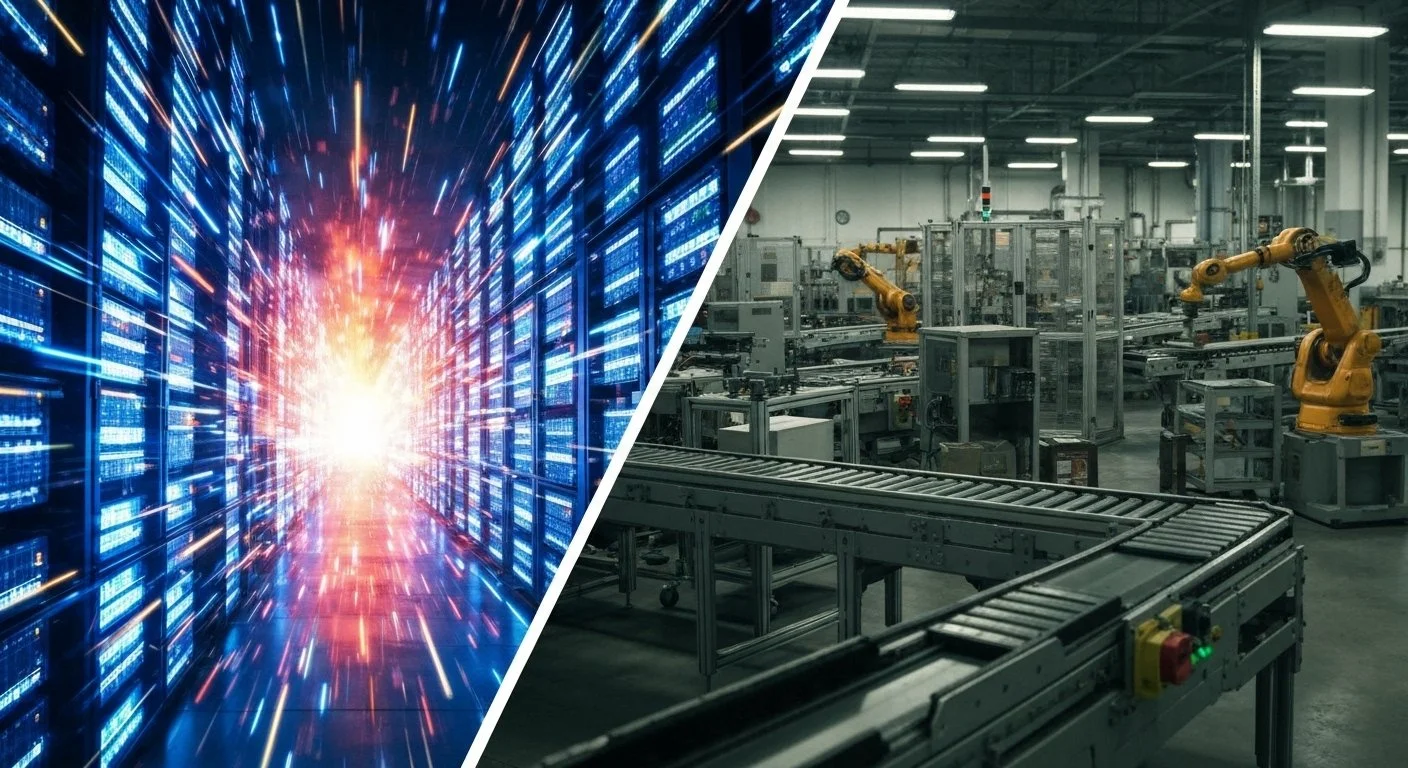
What's interesting is just how huge this growth differential is becoming; we're talking about industrial companies—the folks who traditionally bragged about 2% or 3% annual revenue increases—now seeing organic sales growth of 5%, 10%, or even 15% if they are directly linked to AI infrastructure. Companies like Vertiv, Envent, and Wesco are riding this massive wave of electrification and data center buildout, proving that if you’re positioned in the right vertical, the upside is substantial . I've found that this sudden, insatiable demand for power and cooling has completely reset expectations for what industrial stocks can achieve, making growth, rather than just valuation, the most critical driver of performance divergence in today's market .
Why Are Data Centers Creating Multi-Year Backlogs for Industrial Equipment?
Here’s the thing about the AI boom: it’s not just a software story; it’s an infrastructure crisis disguised as a demand curve. Suddenly, the equipment needed to support these massive data centers—things like transformers, switchgear, and advanced cooling systems—are seeing visibility extending years into the future . Traditionally, industrial backlogs for these companies sat at a comfortable two or three quarters, maybe four if they were lucky, but now, the lead times for critical power and cooling equipment stretch out three to five years . This unprecedented longevity in demand, which is only comparable to the backlog seen in commercial aerospace, tells you everything you need to know about the scale of this buildout .
This leads us to a fascinating counterintuitive insight: the main bottleneck isn’t actually building the data centers—it takes a couple of years for that—it’s getting the power to them . The binding constraint for the entire AI and data center industry right now is simple: "Can they plug it in?" . This urgent need for reliable, base load power is forcing data centers to increasingly locate where energy is readily available, pushing them toward regions like Texas and the Midwest, which is a surprising shift from the traditional tech hubs of Santa Clara or North Virginia . This infrastructural crisis is spurring companies like Eaton, which have a major stake in electrical equipment, to undertake massive capacity expansion, building 12 new plants in the US—a feat they haven’t achieved in 40 or 50 years .
Is the Industrial Sector Stuck in a Housing Slump and Short-Cycle Stagnation?
While the AI infrastructure companies are enjoying multi-year visibility, the rest of the industrial sector—particularly anything touching the consumer—is grappling with significant weakness, forming the lower leg of that K-shaped economic divergence. Housing, frankly, "sucks" right now . Despite the US being short three to five million homes, the residential market is facing a massive correction, with industries like residential HVAC seeing a stunning 10% to 15% year-over-year drop in demand . The hope among companies like Carrier and Lennox International is simply to move from double-digit negative growth this year to flat growth next year, showing just how dire the consumer-facing market remains.
This stagnation isn't limited to housing; it’s affecting the broader short-cycle industrial sectors as well, including businesses focused on industrial automation and general manufacturing like Rockwell Automation and 3M . Here’s the eye-opener: the ISM Index, a key measure of manufacturing health, has been languishing below 50 for three years now, signaling a prolonged period of no growth for these core cyclical areas . On the bright side, we are seeing some qualified evidence that government policy aiming to bring manufacturing back to the US is working, with manufacturing investment more than doubling from about $100 billion five years ago to $250 billion annually today, largely driven by semiconductor fabs and life sciences plants.
What Should Investors Focus On in This Divided Market?
So, if you’re sitting down to figure out where to focus, here is the key takeaway: for the foreseeable future, AI and data center exposure will remain the growth engine of the industrial sector, continuing to drive earnings per share (EPS) revisions and stock outperformance, regardless of currently rich valuations . In a bull market, people prioritize the story and its upward trajectory, and right now, the AI story is getting better every day, making EPS momentum the true metric to watch . Companies like Env, Wesco, and Vertiv remain top picks because their EPS numbers are clearly moving higher, validating their high valuations .
However, I caution against wading too deeply into the consumer and residential housing sectors right now; that’s likely a story for the latter half of the next year, once we see concrete easing from the Federal Reserve . If, and only if, you feel strongly that the housing market will hit an inflection point, the most leveraged stocks in the sector would be Lennox International and Stanley Black & Decker, given their high exposure to residential HVAC and power tools, respectively . Ultimately, while the growth pockets are clear, remaining flexible and understanding which half of the K-shaped economy your investments reside in is critical for navigating this complex industrial landscape.