Is MAGAnomics Just "Chaos," or is There a Secret Strategy?
Here's the thing: when we hear about big economic plans, especially those coming out of high-stakes political campaigns, the media narrative often focuses on disruption and uncertainty. You know, you hear terms like "chaos" or "it doesn't fit our models," especially when talking about policies under former President Trump . But what if I told you that beneath the surface—beneath the headlines that scream unpredictability—there is actually a very well-organized and deeply historical economic program at play? The argument is that what's being dubbed maganomics isn't just a collection of random ideas, but a cohesive machine with three complementary gears designed to fundamentally reshape American finance and industry . This program, they suggest, has been developed over several years, learning from the perceived "wasted opportunity" of the first term and aims to implement a far more strategic vision going forward .
This structured vision is built on three main pillars that guide policy decisions: the three arrows, the american system 2.0, and the Mar-a-Lago Accord . These pillars are designed to interlock and support one another, leading to a specific set of desired results, primarily focusing on managing the country's colossal debt issue not by eliminating it (because let’s be real, that’s not going to happen), but by growing the economy faster than the debt accumulates . It’s an approach that shifts the conversation from outright elimination of deficits to smart, aggressive management. What's interesting is how central this focus on structural sustainability is, contrasting sharply with the common perception that the plan is merely disruptive rather than constructive.
Can We Actually Outgrow the National Debt? (The Three Arrows Plan)
The first pillar, known as the "three arrows" proposed by former Treasury Secretary candidate Scott Bessent, provides a rigorous, mathematical framework for debt management . The central goal here isn't to get the deficit down to zero—since the U.S. hasn't operated without some form of national debt since 1836, when Andrew Jackson paid it off, that's not a realistic modern objective . Instead, the focus is on two key growth numbers and one crucial resource. The first arrow aims to keep annual deficits at 3% of gdp or less, ensuring that new borrowing remains proportional to the nation's total economic output . The second, and perhaps most vital, arrow mandates real gdp growth of 3% or more; when factoring in a conservative 2% inflation, that translates to a nominal growth rate of about 5% .
This 5% nominal growth rate is the secret sauce. Here’s the counterintuitive insight: if the economy (gdp) grows faster than the debt, the crucial debt-to-gdp ratio actually declines, indicating a move toward sustainability . For context, the U.S. debt-to-gdp ratio currently sits at a staggering 123%, the highest in U.S. history, a level that historically slows growth . If this plan were implemented, the ratio would drop from 123% to 121% in the first year, which, while still high, signals the market that the trajectory is changing . The final arrow aims to increase U.S. oil output by 3 million barrels per day, a move intended to lower energy costs, stimulate consumption, and thus contribute directly to the 5% nominal gdp growth target . I've found that people often forget that even small shifts in these huge national numbers can send powerful signals to global markets, and simply moving the debt ratio in the right direction is often enough to quell major anxieties .
What Do Tariffs Have to Do With George Washington and Abraham Lincoln? (The American System 2.0)
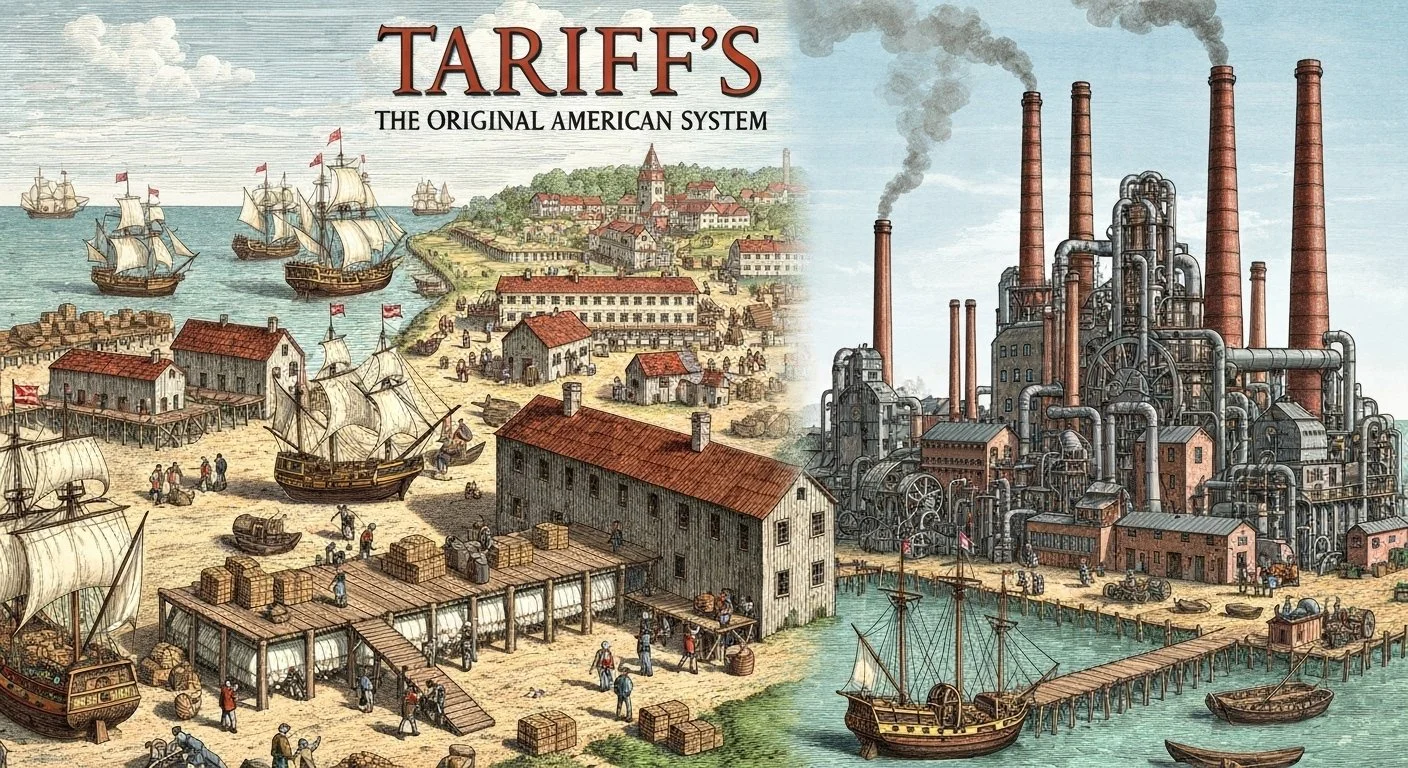
This is where the plan pivots from managing debt to restructuring the entire foundation of U.S. industry. The second pillar, the "american system 2.0," isn’t about inventing new, untested policies; it’s about returning to a set of core economic principles that dominated U.S. policy from 1789 until the 1960s . You know who was a huge fan of this system? alexander hamilton, who invented it in 1790, and abraham lincoln, who expanded upon it . The surprising fact here is that high tariffs, which we view today as radical trade barriers, were the primary source of federal finance for over a century before the income tax was introduced in 1913 .
The goal of these tariffs today is the same as it was historically: to promote domestic industry and high-paying jobs by protecting them from foreign competition . The argument against tariffs is usually that they cause inflation because the cost gets passed to the consumer. But here's the surprising counter-narrative: empirical data shows that in practice, this isn't what happens . From my experience analyzing global supply chains, the truth is that when an importer pays a tariff, they can’t easily pass that full cost to consumers who are already "tapped out" . Instead, the cost is often pushed back up the supply chain, forcing foreign producers—like Chinese factories—to lower their wholesale prices to remain competitive, thus making tariffs non-inflationary in the U.S. . Furthermore, the administration has secured commitments for close to $2 trillion in direct foreign investment by telling global manufacturers, "You can sell whatever you want to Americans, but you have to build it here" .
Why is a Federal Reserve Governor Living in the White House? (The Mar-a-Lago Accord)
This final pillar is perhaps the most complicated and aggressive, focusing on restructuring the global trading and monetary system itself. This component, sometimes called the Mar-a-Lago Accord, takes its name from the venues where major international monetary resets are historically held, such as Bretton Woods or the Smithsonian Institution . The key figure behind this plan is Steven Moran, who has held the unique position of Chairman of the Council of Economic Advisers while simultaneously serving as a sitting Governor of the federal reserve Board . This blending of roles signals a complete erasure of the traditional (and arguably always fictional) wall between the executive branch and the federal reserve, essentially linking monetary and trade policy directly .
The core objective of the Accord is to achieve a cheaper dollar. The current system, where surplus countries like China and Germany invest their massive earnings primarily in U.S. Treasury securities, creates artificial demand for the dollar, overvaluing it and hurting American exports . But here's the major challenge: trading partners can easily defeat U.S. tariffs by devaluing their own currency, essentially making the cost of their goods to Americans the same despite the tariff . Moran's radical solution is to use the U.S. national security umbrella—the collective military and defensive commitments extended to allies—as leverage to compel partners to accept the tariffs and refrain from currency devaluation, essentially using military guarantees to enforce trade compliance . This strategy, sometimes called the "traffic light system," divides partners into Green (friends), Yellow (trade with higher tariffs), and Red (adversaries), tying the geopolitical order directly to economic terms . The surprising historical parallel is that Richard Nixon used similar "carrot and stick" security tactics when establishing the petrodollar system with Saudi Arabia in the 1970s, demonstrating that this strong-arm approach has significant historical precedent in shaping global finance .
So, What Does This All Mean for Your Portfolio?
Understanding these interlocking strategic gears suggests that the policy direction is not random, but deeply intentional. This comprehensive strategy—which aims for sustained growth, protected domestic industry, and a cheaper dollar enforced by security guarantees—has significant implications for investors, particularly when considering the role of precious metals and traditional assets. For young investors often focused solely on the stock market, I want to share a surprising fact: since January 1, 2000, for over a quarter of a century, gold has actually outperformed the S&P 500 .
When the global economic architecture is undergoing such a significant restructuring, true diversification becomes critical. This means going beyond simply owning 50 different stocks in 10 different sectors; that's still just one asset class that will likely fall together in a crisis . Real diversification, in my view, requires slices of cash, stocks, alternatives like Treasury notes, and I recommend having at least 10% in gold, which I see not just as an inflation hedge but as the everything hedge . Gold acts as insurance against everything from civil unrest to deflation, and the recent massive buying by central banks like China and Russia is creating a solid soft floor under the gold price, making its unlimited upside potential a very attractive asymmetric trade right now . So, while the stock market might feel like the default choice, remember that having dry powder—like cash (which is paying 3-4% today) and assets that perform well when everything else crashes—is what allows you to go shopping when the next economic reckoning arrives .