Inflation Has Overstayed for Nearly Six Years. That's the Real 2027 Risk.
A year ago, everything went up
In late October 2025, almost every asset was rising at once: stocks, bonds, gold and bitcoin. The popular explanation was the "debasement trade," the bet that money itself would keep losing value, so anything scarce would keep gaining. Oil was the lone holdout.
A year later, the scoreboard has mostly flipped. From Oct. 31, 2025, to this week, bitcoin is down 43%, gold is down about 7%, and the 10-year Treasury yield has climbed from 4.11% to 5.10%, which means bond prices fell. Oil is up 45%, and the S&P 500 fund SPY is still up about 7%, but only after a 6% slide from its October record.
What changed is the price of money. A year ago, markets were betting on more Fed rate cuts. Instead, the Fed raised rates in September for the first time since 2023, and futures now put about 90% odds on another quarter-point hike in December (InvestmentNews). When cash pays close to 4% with no risk, investors stop paying any price for assets, and anyone who borrowed to buy gets squeezed.
Four borrowers, one pool of money
I find it useful to picture the bond market as a single pool of savings. Everyone who wants to borrow has to dip into it, and when more hands reach in at once, the price of money, the interest rate, goes up. Right now I count four hands.
Washington. The federal deficit hit $1.99 trillion in fiscal 2026, the largest in five years, and debt-service costs reached a record $1.36 trillion (Reuters via GV Wire). Every dollar of that gap is a Treasury bond someone else has to buy.
War. The war with Iran began on Feb. 28. Iran declared the Strait of Hormuz closed, and by March 8 both Brent and WTI crude were above $100 a barrel (IEMed). A war costs borrowed money and pushes up energy prices at the same time, so it feeds the deficit and inflation at once.
Inflation. Tariffs raise what importers pay, energy is up, and consumers are still spending. Lenders who expect prices to keep rising demand a higher rate to make up for it, and the Fed can't look away.
AI. US companies sold a record $1.88 trillion of investment-grade bonds this year through Nov. 4. Amazon, Alphabet, Meta, Microsoft and Oracle raised more than $370 billion of that, roughly a fifth, and Goldman Sachs expects about 35% of their capital spending to be bond-funded next year (Reuters via Kitco).
Any one of these would be manageable. All four at once is why I don't read a 10-year yield above 5% as a blip. It's what money costs when everyone wants it at the same time.
AI is a 1999 story, not a 1995 story
I believe AI will eventually make the economy more productive, and higher productivity is the cleanest cure for inflation there is. My worry is the order of events.
In 1995 and 1996, the internet's productivity gains caught most people by surprise. Growth picked up, but because few people were spending in anticipation of the payoff, inflation stayed tame. By 1999, the story was common knowledge. Households and companies spent ahead of the gains, stocks ran hot, and the Fed raised rates six times in 1999 and 2000 to cool things down.
Chicago Fed President Austan Goolsbee made the same point at a Hoover Institution conference in May. When productivity gains are "widely anticipated," he argued, people spend early, "borrowing from the future," and the economy can overheat. His summary: "The bigger the hype, the bigger the potential for a hangover" (Tiger Brokers).
Nobody is surprised by AI. And before it saves anyone a dollar, it has to be built. Data centers need electricians, steel, copper and power, and all of them get more expensive when everyone wants them at once. The payoff comes later; the bills come now.
That's also why I expect AI stocks to keep swinging. When everyone owns the same idea, every piece of good or bad news hits all of them at once.
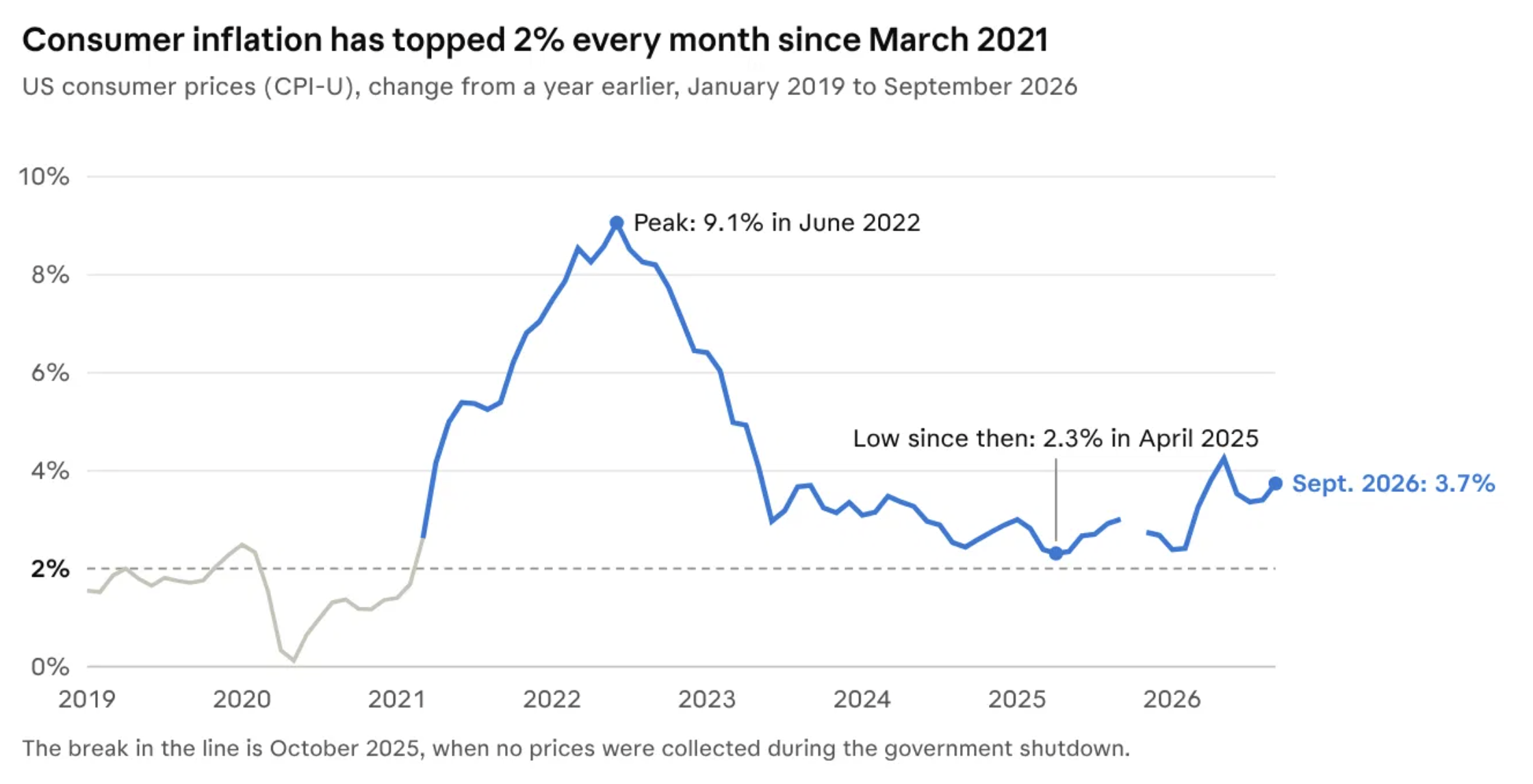
Above 2% every month since March 2021
Here's the number that worries me most. US consumer prices have run more than 2% above their year-earlier level in every month since March 2021. The latest reading, for September, was 3.7% (BLS data via FRED).
[embed: node/77c82390-aa52]
The median projection of Fed officials in September doesn't have the Fed's preferred gauge, the PCE price index, back at 2% until 2029 (Federal Reserve). Counting from 2021, that would be roughly eight years above target.
Consumers have noticed. In the University of Michigan's preliminary November survey, households expected 4.3% inflation over the next year and 3.4% a year over the long run. Both eased a bit from October, but both are well above 2% (The Star).
That's the real risk: not the level, but the habit. Japan spent the better part of two decades expecting prices to fall. People put off purchases because things would be cheaper later, and the waiting kept prices falling. The mirror image works the same way. If people expect prices to keep rising, they buy now, companies stock up on materials early, workers ask for raises sized to past inflation, and all of it keeps inflation going.
Once expectations set like that, inflation gets harder to treat and comes back quickly after each round of medicine. That means rates stay high for longer, which is the opposite of what most portfolios were built for over the past 15 years.
Three things I'm watching in 2027
What the midterms actually change. An election result isn't a policy. What matters for markets is whether the White House and Congress spend 2027 fighting or dealing over tariffs, the Iran war and power for data centers. Like medicine, a new political balance takes time to work through the system.
Whether inflation sets. I'll be watching long-run inflation expectations and the Fed's December projections. If the year the Fed expects to reach 2% slips past 2029, I'll assume rates stay high for even longer.
Whether AI keeps carrying growth. US GDP grew at a 3.4% annual rate in the third quarter, and within business equipment, information-processing gear led the gain (BEA). Rising AI stocks also fund spending by the households that own them. If AI investment or AI share prices stumble, both engines of US growth, investment and consumption, slow at the same time.
So my approach is simple. I'd rather own businesses that throw off cash and don't need cheap money to work, keep bond maturities moderate until inflation proves it's heading down, and size AI exposure for volatility rather than certainty.