Two clocks that have stopped agreeing
I keep two clocks in my head. One tracks the economy: hiring, spending and investment, which turn slowly. The other tracks markets, which run on a shorter cycle of money flowing in and out. Most of the time they show roughly the same time. Right now they don't.
The economy clock still reads "expansion." Real GDP grew at a 3.4% annual rate in the third quarter, employers added 165,000 jobs in October with unemployment at 4.1%, and the Fed's own Oct. 28 statement says activity "is expanding at a strong pace." The OECD's leading indicator for the U.S. was 101.0 in September and still rising, above the 100 line that marks trend growth.
The market clock tells a different story. The S&P 500 set its record on Oct. 6. A month later it had its worst day since April 2025, falling 4.4% on Nov. 5. The Invesco QQQ fund, which tracks the Nasdaq-100, closed that day 14.8% below its Oct. 6 level, and even after the bounce it was still 9.4% lower on Nov. 12 (daily closes).
My read is that the market's short cycle peaked in early October, after a run that started in 2024 and carried through the third quarter of this year. The business cycle hasn't peaked. That gap is where I want my money positioned, because the playbook for "market topped, economy still growing" is different from the playbook for either a boom or a recession.
Why great companies get sold anyway
Big money doesn't start with a stock. It starts with the phase of the cycle, picks the styles that fit it, and only then picks companies. When the phase changes, the weights change, even for a business whose orders are booming.
You can watch it happen. Goldman Sachs' prime-brokerage data showed hedge funds cut net leverage by 4.2 points to 73.4% in October, the fastest cut since March. They were net sellers of global stocks by the most in seven months and sold about $20 billion of tech in two weeks. Five straight sessions of selling AI-linked stocks, Oct. 8–14, erased all of their net buying in that group since the start of 2025. They had gains to protect: the HFRI composite returned 7.6% in the first half, its best start since 2021. BlackRock's investment institute cut U.S. stocks to neutral on Oct. 13 and went overweight short-term Treasuries, ending a six-year underweight on government bonds.
None of that says AI demand is fading. South Korea's chip exports jumped 259% from a year earlier to $56.4 billion in October. That's the point: once the allocation clock turns, a record quarter doesn't stop the selling. In my experience, these rotations take one to two years to come back around, and the next buyers tend to show up only after growth stocks fall far enough to start looking like value stocks.
Here is how I map the phases:
Before the peak: almost everything works, including momentum, smaller companies and emerging Asia.
After the peak, while the economy still grows: quality balance sheets, lower-volatility stocks and defensive sectors, with health care at the top of my list.
In a recession: Treasuries and high-grade corporate bonds. Even defensive stocks fall.
We're in the middle phase.
30/30/20/20 split
My answer to the middle phase is a split I can live with whichever way the next year breaks: 30% growth, 30% defensive, 20% bonds and 20% cash.
30% growth, including AI. I'm not abandoning it. The companies building and using AI still have some of the strongest earnings stories in the market; what's gone is the macro tailwind behind their valuations. After a drop like this, I'll use some cash to add gradually, not all at once.
30% defensive, led by U.S. health care. It's one of the large sectors least tied to the economy, and it has been the clearest winner of the rotation: the Health Care Select Sector fund (XLV) rose 12.4% from the Oct. 6 close to Nov. 12 (daily closes). I mean U.S. health care specifically, because that's where the depth and the steady earnings are.
20% bonds. The 10-year Treasury yield topped 5.3% this fall, its highest in about 24 years, and was 4.99% on Nov. 10. I want to lock in yields like that because I think growth slows over the next couple of years, and rates usually fall when it does. The risk is inflation. October consumer prices rose 0.4% for the month, more than the 0.3% expected, and futures now price about an 85% chance of a quarter-point Fed hike in December and a 15% chance of a half-point one. So I keep this slice in intermediate maturities rather than 30-year bonds.
20% cash. Three-month Treasury bills paid about 4.1% in October, so I'm paid to wait. Cash is what lets me buy weakness instead of selling something else at a bad price.
The chart below shows why I like the structure. I started it on the worst possible day for growth, the Oct. 6 peak, on purpose, because that's when most people buy.
How the split held up
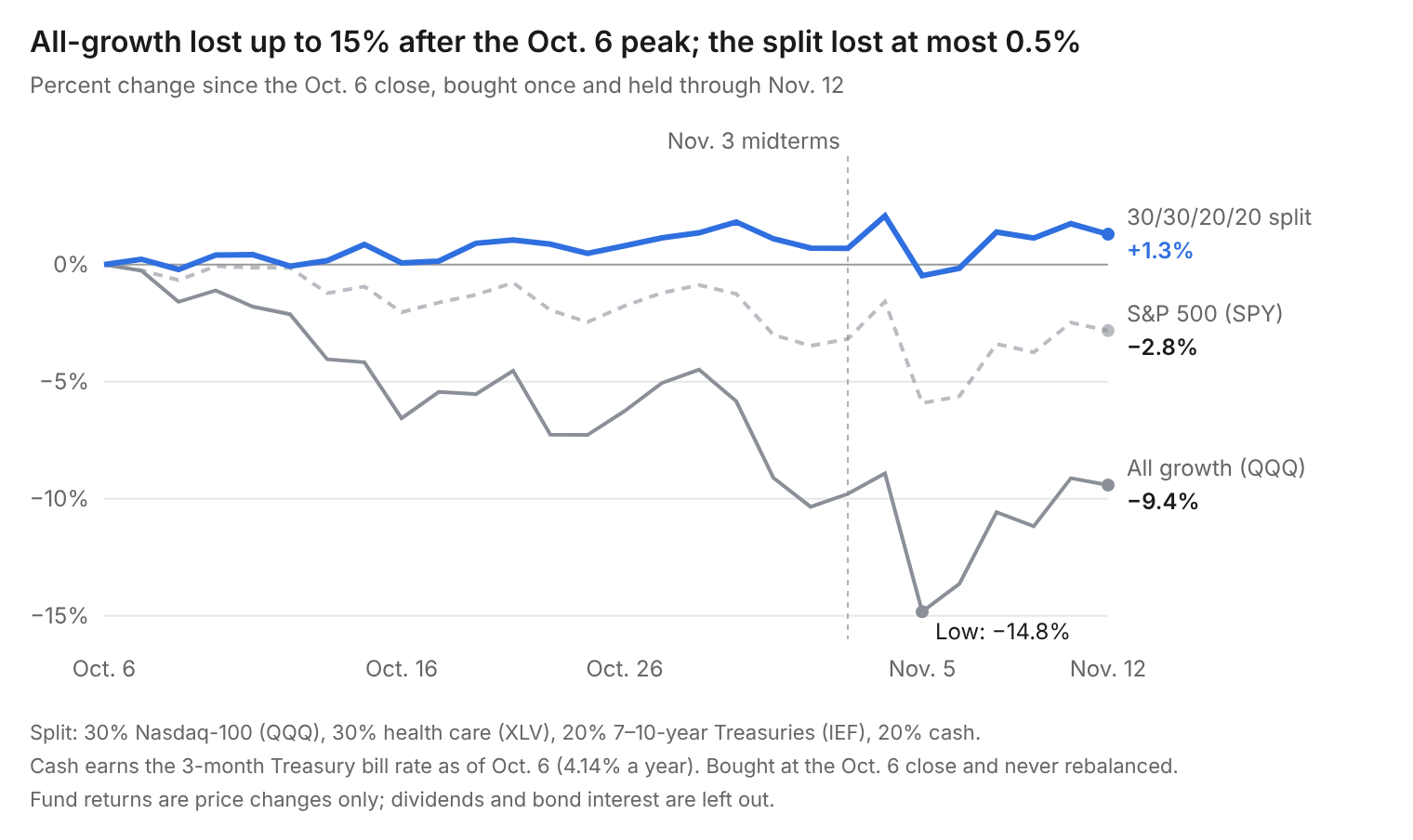
From the record to Nov. 12, the all-growth fund fell as much as 14.8% and finished down 9.4%. The 30/30/20/20 split never lost more than 0.5% and finished up 1.3%.
I want to be honest about what did the work. Health care's 12% run supplied about 3.7 percentage points of the split's return, which is unusually generous, and I wouldn't plan on it. If health care had gone nowhere, the split would have been down about 2.4%, roughly a quarter of the all-growth loss. Bonds helped on the way down, then gave back more than half their gain after the hot inflation report, a reminder that Treasuries hedge growth scares better than inflation scares. A buy-and-hold test from one start date proves little on its own. What it shows is the shape I want: a portfolio that loses a little in the bad weeks, so I can buy in them.
Washington is the swing factor now
I'm spending less time on geopolitics and more on Washington, because U.S. policy is what changed on Nov. 3. Democrats swept the House and the Senate, which sets up three fights I'm watching.
Data centers: rules, not a ban. The election-night fear was that new state leaders would shut the AI build-out down. The details point to slower and pricier, not stopped. Texas Governor-elect Gina Hinojosa has pledged a moratorium on new data center approvals "until laws can be passed by the Legislature". She wants to end nondisclosure agreements, protect water supplies, keep data centers from raising household power bills and end the state's tax subsidies. Gov. Greg Abbott had already paused approvals in August pending an audit. Local opposition was rising long before the vote: Data Center Watch counted about 75 projects worth roughly $130 billion disrupted in the first quarter, roughly all of 2025's total in three months, and 45 more worth nearly $68 billion in the second. My conclusion: capacity that's already built or permitted becomes scarcer and more valuable, while new projects carry more cost and delay. Existing operators look like the relative winners.
The budget and tax fight. Government funding runs out on Dec. 11, and Bank of America expects the $41.1 trillion debt limit to be hit as early as February, with the real deadline later in 2027. Democrats' first priority is restoring the expanded Affordable Care Act premium credits that expired at the end of 2025, at an estimated $350 billion over 10 years. House Democratic leader Hakeem Jeffries has also promised to bring back clean-energy credits. Those compete for the same dollars as the business tax breaks that favor AI spending, and some lawmakers have floated denying bonus depreciation to data centers. With Trump holding a veto, I expect bargaining and brinkmanship, maybe a shutdown, rather than a sudden tax hit to Big Tech. The detail I'll watch is whether any deal changes how fast AI equipment can be written off.
Tariffs and the dollar. After the Supreme Court ruled against the emergency-powers tariffs in February, the administration used a temporary 10% global tariff that expired July 24 and moved to Section 301 cases covering dozens of countries. Trade is one area where a president doesn't need Congress, so I expect more of it now that the White House faces a Democratic Congress at home. I don't think that threatens the dollar's role. It could weaken the won again. The won firmed to about 75 cents per 1,000 won on Nov. 10, and I'd expect it to slip if tariffs return.
Geopolitics still reaches portfolios through one channel: oil. Brent was above $112 at the start of November and $91.49 on Nov. 10, helped by hopes of renewed U.S.-Iran talks. Iran's economy is under heavy strain, with inflation above 80%. I expect oil to stay elevated for a while, but I think the odds of a much wider war have shrunk.
The turn that would make me sell more
If the economy tips toward recession, I'll get much more defensive: fewer stocks of every kind, more Treasuries and high-grade bonds. I don't think we're there. Here's what I'm watching.
Equipment spending. This is the engine. Equipment investment rose at a 20.9% annual rate in the third quarter and added 1.16 percentage points to growth, with information-processing gear alone adding 0.86 points. Business investment as a whole added 1.78. After inflation, equipment spending was about 14% higher than a year earlier. I'm watching that year-over-year rate. If it slows for two quarters in a row, the AI build-out has stopped carrying the economy.
Leading indicators. The OECD's U.S. leading indicator is above 100 and rising, but the monthly gains shrank from about 0.11 points in June to 0.05 in September. In the OECD's terms, a reading above 100 that starts falling marks a downturn. That's my second trigger.
The Fed. The Fed held its target range at 3.75%–4% on Oct. 28, with two policymakers voting for another hike, and markets now expect a December increase. Raising rates into a strong economy is a classic late-cycle sign, though it rarely ends an expansion quickly.
I can't tell you whether the turn is six months away or 16. Until these signals flip, I think the expansion keeps creating opportunities, just not the everything-goes-up kind.
My rule for weeks like this
The last thing I'll do in a week like the one after the election is rebuild my portfolio. Big swings send false signals, and acting on them can cost twice.
Solar stocks show how. The morning after the election, First Solar was up about 8% in premarket trading, and several other clean-energy names jumped 7% to 11%. First Solar closed at $201.14 on Nov. 6, then slid to $172.30 by Nov. 12, below its $185.90 close on Election Day (daily closes). Anyone who sold beaten-down holdings to chase that pop took one loss and then a second.
So my rules are simple:
No allocation changes while volatility is extreme. I wait until the swings calm and the market's direction is clearer. The VIX fell back below 20 on Nov. 9, which is a start, but one calm day isn't a trend.
When things settle, rebalance back to 30/30/20/20. I use the cash slice to add to whatever has fallen most, as long as its business case is intact.
Keep the split even when it feels too cautious. Its job isn't to win next month. It's to make sure I still have money to put to work when the next real opportunity shows up.
This is how I'm positioning my own money, not investment advice. Do your own research or talk with a licensed adviser before acting on any of it.