The trade that carried us has peaked
Investors can't win with bonds right now. When the 10-year Treasury yield hit 5.31% on Oct. 5, the fear was that rates were too high. When it slipped back under 5%, ending October at 4.94%, the fear flipped to recession.
I think both fears miss the real story: the momentum that powered big-cap growth stocks has peaked. From Oct. 6 to Nov. 2, the Invesco QQQ, which tracks the Nasdaq-100, fell about 10% on daily closes. The SPDR S&P 500 ETF lost about 3.5% over the same stretch.
The selling has hit hardest where the momentum was. On Oct. 30, Intel had its worst day on record, Amazon's spending plans rattled the AI trade, and the Nasdaq-100 was on track to shed more than $2 trillion in value for October, even as the Dow headed for a monthly gain.
Big money is adjusting, too. On Oct. 13, BlackRock cut U.S. stocks to neutral, calling it a "short-term risk-management move," and raised short-dated Treasuries to overweight. It also said its convictions on AI "remain intact".
So here is my call. This is not a crash. The economy is still expanding, and I think there are roughly six to 16 months before recession risk takes over. But the index-driven, large-cap bull market is done, and what's left is a stock picker's market.
Momentum peaks before the economy does
I think about markets with two clocks. The fast clock is momentum: yields, credit spreads and which stocks lead. The slow clock is the real economy: jobs, orders and investment. Big allocators move money by the fast clock, which is why stocks can fall while the economy still looks fine.
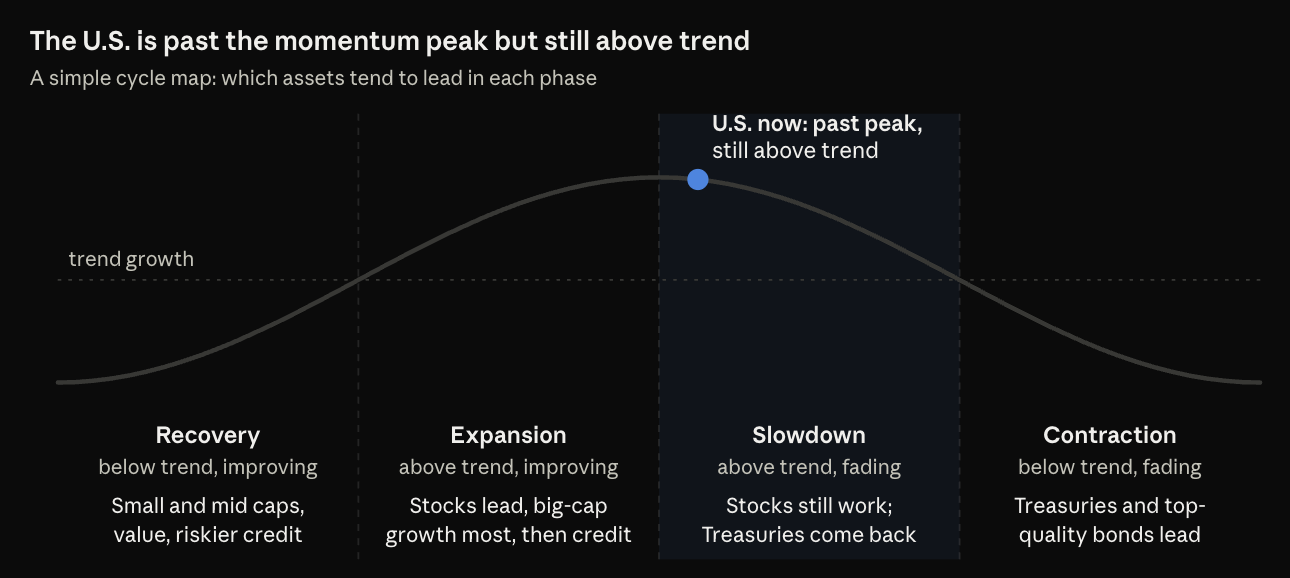
The dot is my read of where the U.S. sits: momentum has rolled over, but growth is still above trend.
Most tactical allocators use some version of this map. When growth is below trend but improving, small and mid caps, value stocks and riskier credit tend to lead. When growth is strong and accelerating, stocks lead, big-cap growth most of all. Once momentum peaks, stocks can still work, but money starts drifting toward Treasuries; in a true contraction, only Treasuries and top-quality bonds hold up.
Right now the two clocks disagree. Fidelity's third-quarter update still describes the U.S. as mid-cycle, with solid activity and early signs of recovery in the labor market. But the fast clock has turned: the momentum leaders are being sold, and BlackRock has cut U.S. stocks to neutral.
That gap is the transition I'm talking about. Nothing has to break for the biggest names to stop leading; the money simply rotates. Whether the market dips further or bounces from here, I doubt the big-cap indexes reclaim their early-October highs anytime soon.
Why I'm not selling everything
A peak in momentum is not a recession. The slow clock is still ticking up, and the latest data are hard to square with a downturn.
The economy grew at a 3.4% annual rate in the third quarter. Business fixed investment rose 12.7%, with equipment up 20.9% and data center construction up 127%. Spending like that doesn't just build servers. It pulls in financing, keeps the bond and IPO windows open and pays a long chain of suppliers.
The leading indicators agree, at least for now. The Conference Board's Leading Economic Index was flat in September, but its six-month growth rate turned positive at 0.6%, and its recession signal is not flashing. The board expects growth of 2.2% this year and 2.0% in 2027.
That's why I put real recession risk six to 16 months out, not now. The end of a bull market isn't the start of a bear market. In between, there is usually a long, choppy stretch where the index goes nowhere and money hunts for specific winners.
Where I'm looking: a stock picker's market
If the index trade is over, where does the money go? Under the surface, it's already moving: out of the momentum leaders and into sectors like health care.
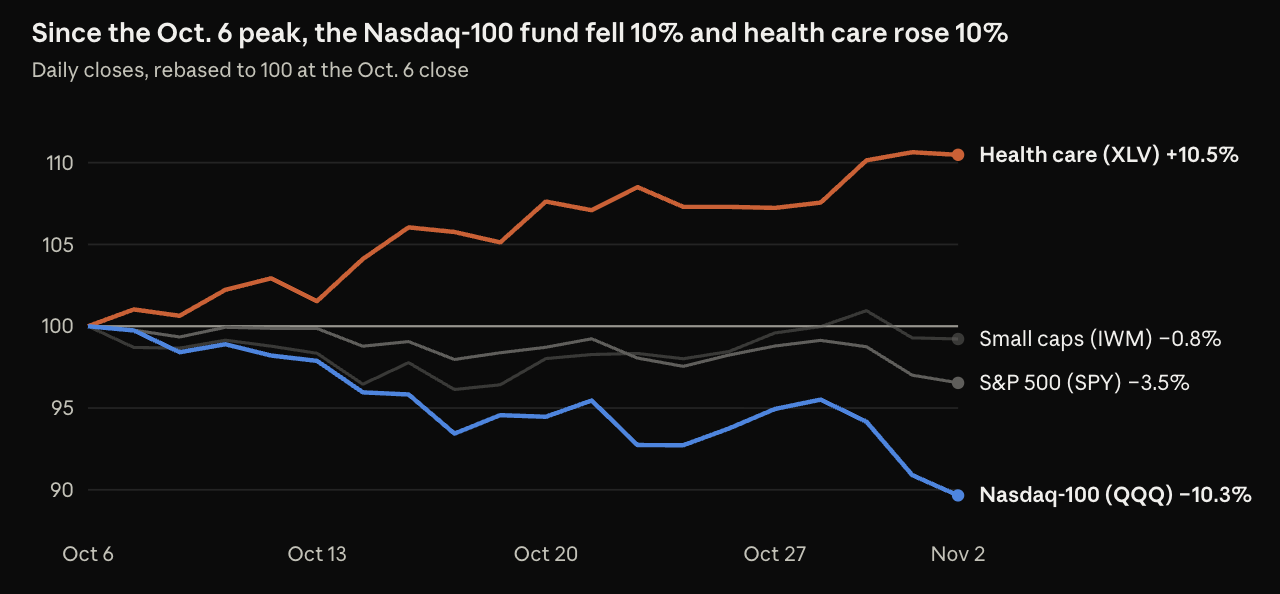
Small caps held roughly flat, which tells me this is a rotation, not a rush for the exits.
I sort the opportunity into three groups.
Suppliers to the big spenders. The giants made their money, and now they have to spend it to defend their market share. Micron expected its capital spending to top $25 billion in the fiscal year that ended in August, and it plans to raise that by more than $10 billion in fiscal 2027. SK Hynix's CEO expects 2027 to be the tightest year the memory market has ever seen. That money flows to equipment, materials and parts makers, many of them mid caps.
Data-rich industries using cheap AI. Health care is my best example. Its data, from prescriptions to patient records, are already well organized, so even a mid-tier AI model can produce real results on a small R&D budget. I think that's part of why the sector has run.
Consumer companies that mine their own data. Working out which product to pitch to which age group in which neighborhood used to take a seven-figure consulting contract. A light AI model can now do much of that in-house.
I want to be careful here. Defensive playbooks favor big, high-quality companies over small caps, and the Russell 2000 fund is still about 8.5% below its August high as yields climbed. So this isn't a call to buy the small-cap index. It's a call to find the smaller companies that turn AI into real sales and margins, the ones that answer the market's worries about investment and profits.
The midterms: delay, not collapse
Today's vote is the event everyone is bracing for. On Monday, Kalshi traders put Democrats' odds at 94% for the House and 74% for the Senate. So I'm treating a blue wave as the base case.
The fear is easy to list. A Democratic Congress would go after the tax cuts, use war-powers votes and the budget to rein in the Iran war, and push new rules on data centers. Each would hit a theme the market has been paying up for.
But the math cuts the other way. Trump will veto what he dislikes, and overriding a veto takes two-thirds of both chambers, or 67 senators if all are present. No forecast I've seen gets Democrats anywhere near that.
He also governs by executive order: 288 of them in this term through September. Every order Congress wants to block needs its own bill, and every bill risks a veto. That leaves a gray zone where policy keeps moving even under a hostile Congress; my guess is that a blue wave delays maybe 30% of the agenda rather than stopping it.
I don't buy the lame-duck story, either. Trump can't run again, but Republicans still need his agenda to win the White House in 2028, so the party isn't going to scatter.
Data centers are the clearest case of delay over collapse. In Ohio, Democrat Amy Acton backs a conditional moratorium ("We are absolutely open, but we're not for sale"), and Republican Vivek Ramaswamy would also halt new approvals until data centers pay their way.
In New Mexico, Democrat Deb Haaland would pause new large projects until the state adopts protections, arguing that "innovation and protection are not mutually exclusive". That points to a slower, costlier build-out with clearer rules, not a dead one.
Iran is where a new Congress could matter most. The House has voted three times to end U.S. involvement, with seven Republicans joining on the latest vote, and the Congressional Budget Office puts the war's cost at $38 billion over six months, rising by about $3 billion a month.
War-powers resolutions still face a veto, so the real lever is money: a Democratic House can refuse to fund an open-ended war in the next spending bill. I expect the conflict to shift from escalation to management after today, and markets would welcome that.
How I'm positioned now
I'm not running for the exits. I'm changing what I own.
Less index, more selection. I'm not adding to the big-cap growth names that led the last two years. New money goes to smaller companies that turn AI into sales and margins, to suppliers of the chip and data center build-out, and to health care.
Cash that earns. For the defensive part of the portfolio, the 2-year Treasury still yields 4.56%, with far less rate risk than long bonds.
Patience on Korea. I'd wait for the selling in the big chipmakers to exhaust itself before adding.
Three things would change my mind. If the leading index's six-month growth rate turns negative again while business investment stalls, I'll pull my recession window closer. If the big-cap indexes break to new highs with broad participation, I'll admit my momentum call was early. And if a new Congress moves fast on tax hikes and spending cuts, I'll get more defensive.
The easy phase of this bull market is over. The expansion isn't, and that's a market that rewards stock picking over index hugging. This is how I'm thinking about my own money, not advice for yours.