Why is Everyone Suddenly Fighting Over Greenland? (It's Not Just Ice)
Have you ever wondered why a giant, frozen chunk of land in the North Atlantic—Greenland—keeps popping up in geopolitical headlines? Here's the thing: it’s not just about icebergs or polar bears anymore; it’s a high-stakes chess match played out over vital defense lines, enormous untapped resources, and the future of global shipping routes. What seems like a quirky request from a former U.S. President to buy the island actually reveals a much deeper, more intense struggle for Arctic dominance, one that pits traditional allies against each other and sets the stage for new great power competition. Let's dive into the fascinating, complex reasons why Greenland has become the most coveted piece of real estate on Earth.
Is Greenland Just a Big Military Base Disguised as an Island?
When the idea of the U.S. acquiring Greenland surfaced, the official rhetoric quickly shifted away from mere resource acquisition and focused intensely on security—and you know, when politicians start talking about "security," it usually means something far more urgent than they let on . The core argument was that Greenland is geographically essential for defending the American homeland, especially the critical cities like Washington D.C. and New York . This sounds a bit dramatic, until you consider the alarming resurgence of military activity in the Arctic from countries like Russia. I’ve found that geography often trumps politics in the long run, and Greenland's position right between North America and Europe makes it an irreplaceable bulwark against incoming threats, particularly the terrifying prospect of long-range missiles and bomber attacks .
What’s interesting is that this focus on defense is largely driven by a new technological reality: the rise of hypersonic missiles . These weapons are so fast that traditional warning times are drastically reduced, meaning the ability to intercept threats close to their source—or even better, to monitor their launch—becomes paramount. Russia, for example, is heavily fortifying its Arctic flank, concentrating the vast majority of its naval power, including nuclear submarines, in its Northern Fleet Command . This isn't just a minor military presence; it's a massive deployment of frigates, bombers, nuclear subs, and even ground forces, far exceeding Cold War levels . Why? Because the Arctic provides the shortest distance for a second nuclear strike capacity against the U.S. and Europe . Therefore, holding Greenland isn't about offense for the U.S.; it's about pure, desperate defense against a rapidly arming adversary, making the country’s security argument surprisingly valid.
This immediate security need is so intense that the political cost is deemed worth the fight, even if it means clashing with NATO allies. When several European nations sent troops to prevent any forced U.S. merger, the response was a threat of punitive tariffs—10% initially, escalating to 25%—against eight key European partners . Here’s a truly counterintuitive insight: many European nations, despite knowing the economic harm, resisted solely based on pride, refusing to allow a "new nation like America" to simply snatch European territory . This dynamic creates a risky intra-NATO spat , where the desire for strategic security (U.S.) clashes directly with European historical sovereignty and pride, confirming that control over Greenland is deeply intertwined with who holds power in the changing Arctic landscape.
Who Really Controls the New Silk Road of the Seas?
The heating up of the Arctic isn’t just warming the climate; it's melting open entirely new global trade arteries, and Greenland is the toll booth. Historically, the Arctic was impassable due to thick, year-round ice. But as we've seen since 2020, large sections of the crucial routes—especially the Northern Sea Route hugging the Russian coast—are now navigable for several months a year . This Blue Arctic Route, connecting Europe, Russia, and Shanghai, is shockingly short: about 10,500 km, which shaves 15 days off the Suez Canal route, effectively allowing one ship to do the work of two. This makes Greenland, and its nearby partner Iceland, central to the flow of this new maritime highway.
This leads us to the hidden value often overlooked in the geopolitical scramble: submarine data cables. Here’s a fact that might surprise you: 95% of all data and voice traffic between continents zips through these underwater fiber-optic lines . A shorter sea route means shorter cables, lower construction costs, and faster data transfer—crucial for modern finance and global communication . But these cables serve a dual purpose beyond civilian internet: they can be equipped with hydrophones and acoustic sensors, essentially turning the seabed into a massive, real-time sonar network capable of monitoring all subsurface military activity, like the movement of nuclear submarines and fleets.
From my experience observing global infrastructure, wherever data flows, surveillance follows. China, recognizing this, has been aggressively investing in Arctic infrastructure, pouring roughly $2 billion into Greenland between 2012 and 2017—an astounding 11.6% of the island’s GDP at the time . Furthermore, Chinese companies like Huawei Marine are actively laying these exact types of data cables along the Arctic route in partnership with European firms, effectively giving Beijing potential eyes and ears into crucial naval movements, especially those of the U.S. Navy and submarines . If the U.S. doesn't secure Greenland, it loses its leverage over both the physical trade routes and the unseen data highways, giving rivals a massive strategic advantage in monitoring and potentially disrupting global communications—or even physically cutting cables, an increasing phenomenon often attributed to state-sponsored actors.
Is the Real Treasure Found in Rare Earths and Oil?
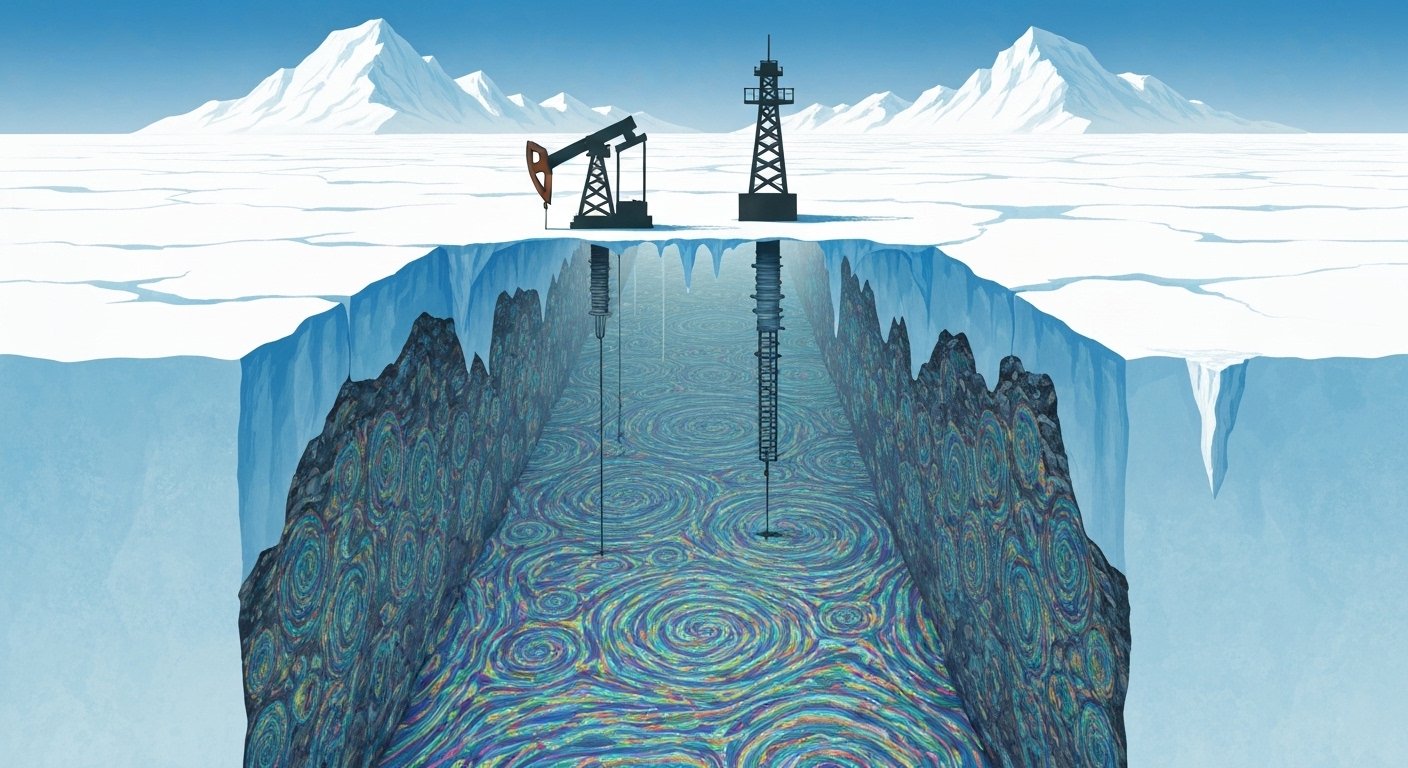
Beyond military defense and logistics, the massive economic potential locked beneath Greenland’s ice is a compelling force driving this territorial desire. While many focus on the highly publicized rare earth elements (REEs), which are vital for everything from AI chips to defense technology, there's another resource far more voluminous and immediately impactful: oil and gas . Greenland's flanks sit atop potentially immense reserves of crude oil and natural gas. Securing these reserves would drastically alter the global energy landscape, especially for the U.S. .
If the U.S. secures Greenland, it significantly increases its proven oil and gas reserves, adding to the huge stockpiles already present in Alaska . This isn't just about market control; it’s an intentional geopolitical strategy to secure energy dominance and reduce reliance on volatile foreign sources, making the country less vulnerable to global price fluctuations . For the U.S., which still relies on natural gas for about half of its electricity generation, securing this source aligns perfectly with a broader long-term strategy centered on gas and nuclear power, potentially challenging the global shift toward renewables that China currently dominates.
But let's not forget the rare earths. Although mining them is currently expensive due to the harsh climate, the value is less economic and more about security of supply . China currently controls the vast majority of the global REE market, giving them a chokehold on supply chains essential for virtually every high-tech and military component, from sophisticated radar systems to electric vehicle batteries . Greenland holds some of the largest known deposits outside of China. Securing access means the U.S. can prevent Beijing from weaponizing its supply chain dominance, making the REE value here primarily a matter of national security rather than immediate profit . In essence, whether it’s the massive oil reserves or the critical rare earth minerals, the underlying motivation for wanting Greenland is clear: it’s the ultimate insurance policy against economic and strategic vulnerability.