Is the Age of Traditional Telecom Coming to an End?
We live in an era where we carry tiny supercomputers in our pockets, capable of calculating things Einstein couldn't have dreamed of, yet the moment we step off the beaten path—into a desert, a mountain range, or even just a slightly remote public park—our phones turn into expensive bricks . This isn't just a minor inconvenience; it highlights a massive, looming gap in our connectivity infrastructure, especially when you consider that roughly 90% of the Earth still lacks reliable cellular service . Here’s the thing: while we talk endlessly about on-device AI and the hyper-connected future, that future simply cannot arrive if our networks choke the moment we leave a major metropolitan area.
I've found that even in places that should be technology hubs, the connectivity struggle is real, often hilariously so. Think about attending major tech events like CES in Las Vegas or MWC in Barcelona, which are supposed to showcase the world's best communication technology; you're paying top dollar for a hotel room only to wrestle with Wi-Fi so slow it takes four or five hours just to upload a single video . It's almost unbelievable that the 'mecca of technology' can deliver such a soul-crushing experience ! This problem exists because traditional telecom companies simply won't invest millions in building cell towers in areas where the only "customers" are a few cows and a lone farmer—it just doesn't make financial sense . But the stakes are rising dramatically now; if self-driving vehicles, flying electric UAMs, or factory humaoids enter one of these communication 'dead zones,' the consequences could genuinely be fatal . This terrifying reality is why the biggest players in tech—Google, Nvidia, and even Samsung—are suddenly pouring money into orbital solutions.
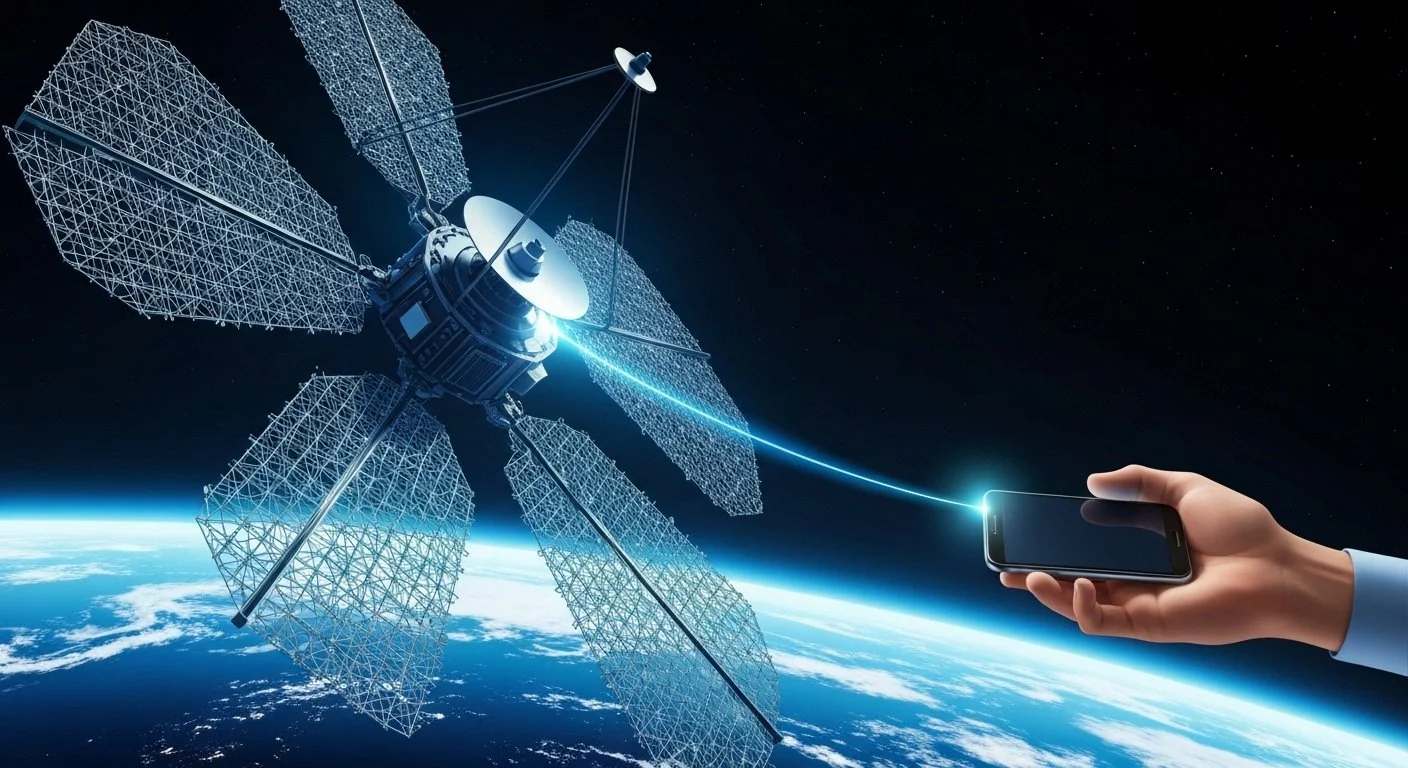
Why is a Giant Space Listening Device Making Elon Musk Sweat?
If you've been following space news, you've probably heard of Starlink, which offers a great solution: take a pizza-sized dish, set it up, and connect to the internet. This model has proven incredibly effective, even playing a crucial role in maintaining communication when traditional ground infrastructure was destroyed, like in Ukraine . However, asking people to carry a dish just to get hotel Wi-Fi—or worse, installing one on every autonomous vehicle—is not practical for the everyday smartphone user . What we truly want is the ability to connect immediately, directly from the phone already in our pocket, without needing extra equipment or modifications.
This is where AST SpaceMobile (AST) enters the picture, and trust me, they're approaching this challenge completely differently than Starlink . Instead of telling you to use a giant antenna as a megaphone to shout up at the sky, AST is essentially putting an "oversized hearing aid" into orbit . Their BlueBird satellites utilize colossal phased array antennas. The initial prototype, BlueWalker 3, was already massive at 64 square meters, but their latest design, the BlueBird 6, is nearly ten times larger, covering an astonishing 223 square meters. This successfully launched giant, which is the largest commercial satellite currently in Earth's orbit, gives them a massive competitive edge.
This enormous antenna size is the key difference and, frankly, the counterintuitive insight: by having such a ridiculously huge surface area, the satellite can dramatically increase its sensitivity . This increased sensitivity allows it to capture and process the incredibly weak, faint signal coming directly from a standard smartphone on the ground . What’s more, AST has developed advanced technical capabilities to compensate for the Doppler effect, which normally distorts and degrades the sensitive LTT/5G signals because the satellite is moving at thousands of miles per hour . These combined technologies mean AST can precisely focus a radio beam from hundreds of kilometers in space directly onto a single, specific smartphone . That’s why its stock price has soared nearly fourfold in a year.
Why Are AT&T, Google, and Vodafone Joining Forces?
Here's the most surprising part: the traditional telecom giants are not fighting this space technology; they are funding it out of sheer terror . Major U.S. carriers like AT&T and Verizon—the SKT and KT of America—have made strategic investments in AST . Why would they bankroll a company that could potentially disrupt their entire ground-based business model? Simple: fear of domination by Elon Musk's Starlink. If Starlink were to team up with a major mobile operator like T-Mobile and declare they could offer service everywhere on Earth, the traditional carriers would be finished.
This leads us to a fascinating global alliance: the world’s telecom armies banding together to hedge their bets. By pouring cash into AST, companies like AT&T and Verizon are creating a powerful alternative to check Starlink’s potential monopoly . This alliance isn't small, either; it includes Europe's Vodafone, Japan's Rakuten, Canada's Bell, and tower infrastructure leaders like American Tower . It's safe to say that a worldwide coalition of telecom companies is strategically investing in AST to ensure they don't lose their massive customer base to Musk's orbital venture . Google has also joined the fray, raising speculation that the Android operating system itself might soon natively support satellite communication, making AST an essential partner.
From my experience observing these high-stakes technology battles, the risks are colossal; satellite launches face delays, require immense capital expenditure (CAPEX), and face regulatory hurdles, meaning failure is a very real possibility . However, this is precisely the nature of truly transformative, high-risk, high-reward endeavors. The key takeaway here is that whether the winner is Starlink or AST, the competition and the massive capital injection are rapidly guaranteeing one outcome: true global connectivity, where your smartphone works absolutely everywhere, is no longer a futuristic pipe dream; it is an inevitable reality driven by panic and ambition.