2026 Quick Highlights on Crypto, AI, Currency & Geopolitics
Is the Future of Tech a Bubble or Just the New Normal?
Here's the thing: whenever a truly transformative technology arrives, we immediately start asking if it’s a bubble, right? We saw it with the early days of the internet in the late 90s, where everyone thought a "new world" was opening up, only for it to become just a natural, necessary tool within five or six years, whether a crash happened or not . Now, we're doing the same dance with AI, and frankly, everyone knows the cycle is coming—it's just a matter of timing, and you know how markets are: the moment everyone thinks the crash is imminent, it often doesn't happen . The real sticking point right now isn't the technology itself, which is undeniably powerful, but whether companies can actually translate that innovation into massive, concrete profits that they can return to shareholders or fuel exponential growth .
What's interesting is how fundamentally different this AI boom might be compared to the early 2000s IT bubble. The scale of the impact is just so much grander, demanding fundamental changes in infrastructure like power and energy—something that wasn't as pronounced in the dot-com era . From my experience, when something requires such an earth-shattering shift in basic utilities, the resulting market is usually more resilient and deeper than a simple burstable bubble . In fact, many experts predict that 2026 is the year where the impact of AI on productivity will stop being theoretical and truly start creating measurable differences across industries .
This focus on infrastructure leads us to a fascinating, somewhat scary trend: who is funding the massive AI cloud expansion in the US? It's often not the Big Tech companies directly, but real estate and asset management firms backed by mutual funds, essentially operating like "knowledge industry centers" in our markets, building the physical infrastructure . This structure allows the big players to shed risk, only paying their pre-determined fees if something goes wrong, instead of owning the depreciating assets outright . This also raises a critical, counterintuitive question: as AI chips continue to advance rapidly, what happens to the massive inventory of slightly older, "former generation" chips in three years? If no innovation arises to utilize these aging assets, the depreciation cost for the industry could be staggering, which means the true profits of AI are still deeply intertwined with hardware cycles and infrastructure management.
Has Bitcoin Lost Its Original Edge to Centralization and Convenience?
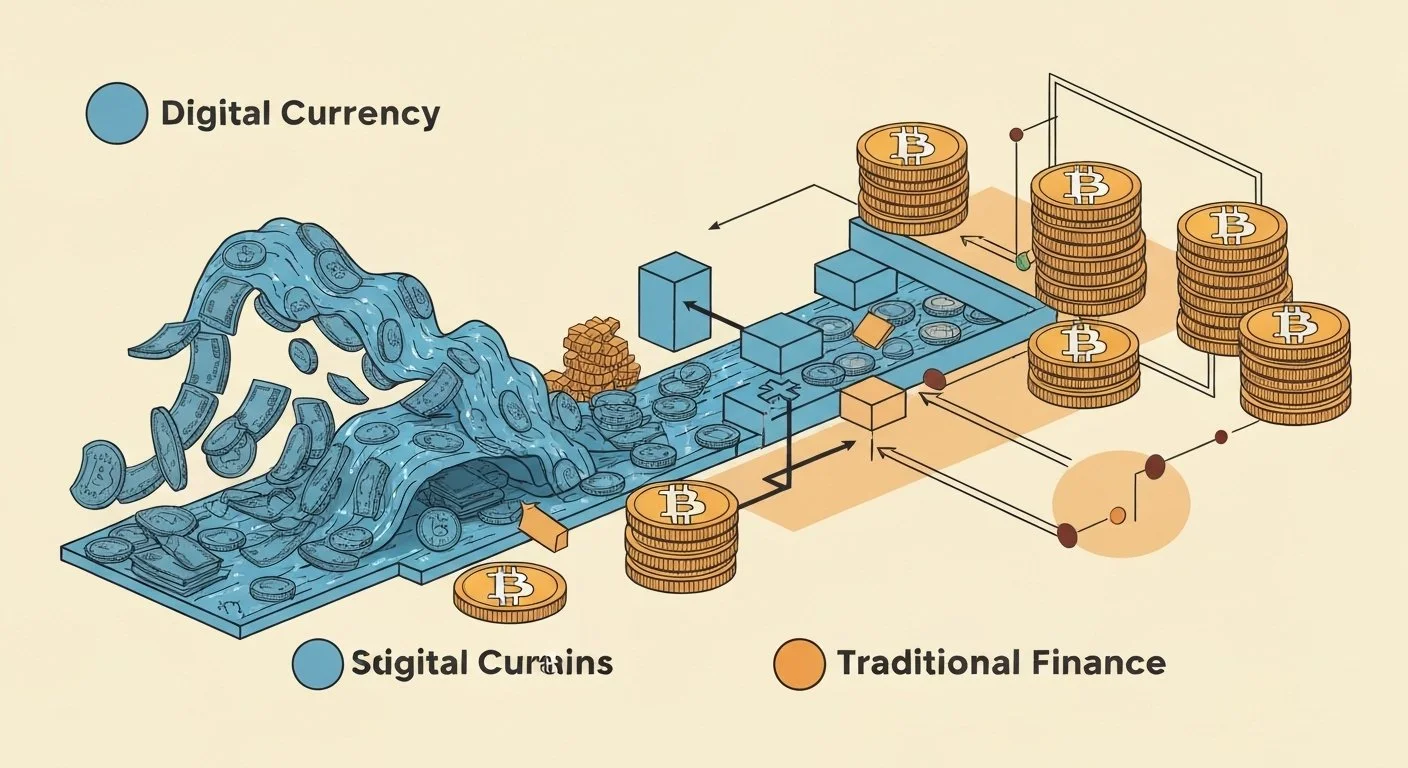
When we talk about virtual assets like Bitcoin, we often remember their initial revolutionary promise, especially concerning geopolitical limitations—the idea that it transcended borders, avoiding things like tariffs and seizures, giving it significant global power, similar to how early free trade was viewed . Another huge advantage, especially compared to physical assets like gold, was its portability and divisibility, making it incredibly easy to move large value across any distance . However, the market has certainly seen better days, and while there are technical reasons like the "halving" or shifting demand due to rising interest rates, the deeper issue is structural .
Here's a surprising fact: many of the core benefits Bitcoin championed in the early days—let’s say around 2017—have actually become outdated or ironically centralized . We initially spoke about decentralization, but the reality is that the typical user trades through a highly centralized financial system, which is the complete opposite of Bitcoin's founding philosophy . I've found that this drift away from the core principles of decentralization and toward transactional convenience is starting to create space for competitors .
This leads us directly to the rise of alternatives like Stablecoins, which address one of Bitcoin’s primary remaining uses: the ease of remittance, particularly in developing nations. Stablecoins can solve the transfer problems without the intense price volatility or the difficult technical knowledge required to safely store assets in a "cold wallet"—because let's be honest, setting up secure storage is still way too complicated for the average person . While Stablecoins can’t replace all the value propositions of Bitcoin, any asset that manages to replace even a few of its essential functions creates a relative contraction for Bitcoin's utility . Just like gold, which can go sideways for a decade before catching up to equity gains, Bitcoin is now undergoing its own severe volatility phase, forcing everyone to question whether it can truly sustain its long-term value in this new landscape.
What Does China’s $1 Trillion Trade Surplus Mean for the Global Economy?
Moving onto geopolitics, 2025 was a pivotal year for the US-China relationship, not because things got particularly bad, but because the US fundamentally adjusted its expectations . America essentially admitted, "We can't just crush them anymore," recognizing China as a formidable counterpart—a scary friend, if you will—whose core interests must be managed but not necessarily attacked if they don't threaten US vital interests . This shift has established a kind of "new normal" in the business relationship, where collaboration can occur outside of a few key, protected sectors like AI, humanoid robotics, and advanced chips .
The situation within China, however, is a fascinating paradox that is important to grasp. On one hand, China is an astonishingly successful nation in nearly every field—except, perhaps, football, as one observer humorously noted . Last year, China achieved an unprecedented feat, recording a trade surplus exceeding $1 trillion, a historical first for any nation . But, here’s the surprise twist: internally, China is grappling with serious deflation and economic slowdown, compounded by severe fiscal difficulties in regional governments, which are usually the primary drivers of investment and growth .
This internal weakness is directly linked to the massive external success. Because domestic demand is so poor—for example, the price of a new car fell by 25% within six months last year, discouraging consumers from buying—China is pushing all that inventory onto the global export market . While this earns them a spectacular amount of foreign currency, it is a sign of internal distress, raising alarms among Chinese leaders who must be wondering if they are following the path Japan took in the 1990s . Fixing this requires a complete system overhaul: shifting from investment and export-driven growth to a model centered on consumption and robust social welfare to ease citizens’ concerns about the future . This internal conflict, where leaders are reluctant to abandon their authoritarian model for consumption-led growth, suggests that while China won't collapse overnight, it has entered a stage of chronic malaise .
Is Europe Ready to Face the Next Stage of Conflict?
The conflict in Ukraine presents a situation where even if the fighting stops, the repercussions won't, leading to a new set of tensions and conflicts—it's a scenario of "over even if it’s over" . What’s truly striking, and something I think many observers overlook, is the demographic shift in the actual fighting force. Historically, wars have been fought by the youngest generations, sometimes wiping out an entire cohort, as happened to France in WWI .
However, in the current conflict, the majority of soldiers on the frontline in both Ukraine and Russia are often not fresh-faced young men, but middle-aged individuals, frequently in their mid-40s to mid-50s . In Russia, where life expectancy is relatively low, people from impoverished regions are incentivized with substantial one-time payments—roughly $150,000—to serve, making the high-risk endeavor an economically viable decision for those facing poverty . This grim reality—a war fought by middle-aged men and drones—paradoxically allows the fighting to drag on far longer than traditional conflicts because the societal impact is less immediate or acute on the youth, making it politically "bearable" for the nations involved.
This slow-burn conflict is now pushing Europe to a genuine test of self-reliance in 2026 . With the US increasingly signaling a reduced role and European leaders like Germany and France formally reintroducing some form of conscription, Europe is forced to manage its own security issues . The big question is whether the disparate nations, which have historically struggled to achieve consensus, will now demonstrate the unified, practical self-determination needed to address the persistent threat from Russia . I sincerely hope that 2026 forces Europe to abandon its historically condescending attitude and embrace the practical reality of solving its own problems.
Will Affordability Become the Dominant Political Battleground?
If I had to pick one keyword that will define the socio-economic landscape in 2026, it would be “Affordability.” You see this brewing frustration everywhere. From what I've observed in conversations with global leaders, like those involved in the US presidential and New York mayoral races, the consensus is clear: the high cost of living is causing real anger, and addressing this is the core task of governance .
Affordability, in this context, means the ability to earn a wage, cover basic expenses like housing and necessities, and still comfortably manage a household . Right now, this situation is rapidly deteriorating globally. In major cities like London, you might be paying over half your income just in rent, and the prices for energy and essentials are skyrocketing . Even though many European countries don't have major elections in 2026, politicians know they must deliver a tangible improvement in living costs before the 2027-2028 election cycle .
This necessity may drive political leaders to adopt drastic, even radical measures that we haven't seen before to lower costs—and this is where things get complicated . For example, in places like New York or California, to combat prohibitively high housing costs, state governments are reclaiming power from local authorities to rapidly approve and build more housing, effectively overriding the objections of current homeowners who fear loss of property value or obstructed views . This highlights a critical tension: governments may act to improve affordability for the majority, but the process may necessarily step on the toes of powerful, entrenched minority interests . The great debate of 2026 will be whether society accepts the sacrifice of entrenched privileges for the greater good of national affordability.