Why is Trump Suddenly Focused on Greenland?
President Trump are suddenly spotlighting places you might not expect, like Venezuela and the distant ice of Greenland. It seems confusing, doesn't it? But here’s the thing: these seemingly unconnected issues often share a deeper strategic context, especially when we talk about shifts in global power and influence. It’s less about random targets and more about a calculated strategy to reassert American influence where it believes it belongs—the Western Hemisphere.
What’s interesting is that many of these targeted regions—Venezuela, Iran, and even the discussions around Ukraine—are traditionally close allies of Russia. From my experience watching geopolitical maneuvering, when a major power like Russia is distracted by a huge conflict, its traditional allies become vulnerable, and that’s precisely when rival powers move in. Russia, deeply entangled in Ukraine, simply doesn't have the capacity or the "mental space" to provide the level of support or projection it once did for distant partners like Venezuela. This vulnerability creates windows of opportunity for intervention, making a long-held anti-Maduro stance much easier to execute when Russia is tied up.
This leads us to a fascinating, and somewhat unsettling, view of how the world order is being re-imagined. Trump’s actions, such as targeting the Maduro regime, aren't just about isolating a leader; they echo a principle that President Putin uses regarding Ukraine: claiming an exclusive sphere of influence . Trump basically says, "The Western Hemisphere is mine; no one challenges American hegemony here" . This worldview—where powerful nations unilaterally define and guard their exclusive regional zones—is a return to a "great power politics" similar to the post-WWII Yalta arrangements, where the world was carved up into spheres of control . It implies an acceptance of Russia’s traditional sphere in post-Soviet states while fiercely protecting the U.S. zone, suggesting a willingness to strike deals and manage competition rather than adhere strictly to global rules.
Is the New Global Strategy a Return to "Sphere of Influence" Politics?
If you look closely at the priorities being set, you'll find that traditional allies are being treated less like friends and more like bargaining chips or necessary evils. For instance, the U.S. National Security Strategy under a potential Trump administration views the quick conclusion of the Ukraine war as a key American interest, yet it surprisingly avoids criticizing Russia for the invasion . Instead, the strategy criticizes European leaders for having "unrealistic expectations" that they can actually defeat Russia on the battlefield, suggesting they should accept the current reality of the frontlines.
This shift in focus explains why Europe's status in American foreign policy has dropped significantly. While historically seen as an essential partner, Europe is now treated as a lower priority, seen by some in the U.S. as a region that needs to acknowledge its limitations. This perspective suggests the U.S. is pushing for a settlement that accommodates Russian regional interests in the former Soviet space, which is a significant strategic retreat from the post-Cold War NATO expansion strategy . The key insight here is that the new era of diplomacy isn't about promoting global democracy or adherence to international law; it's about power being the rule, and rules being determined by power .
This focus on regional hegemony started close to home. Immediately upon taking office in his first term, Trump started challenging America’s neighbors. He tried to rename the Gulf of Mexico the "American Gulf," pushed Canada to consider becoming the 51st state, and challenged Chinese influence in the Panama Canal . This behavior highlights a core characteristic of sphere-of-influence politics: the nation often treats nearby neighbors more harshly than distant rivals . This continuous assertion of dominance—from the very border up through Central America—lays the groundwork for understanding the fascination with Greenland.
Why is a Vast Ice Sheet the Next Geopolitical Battleground?
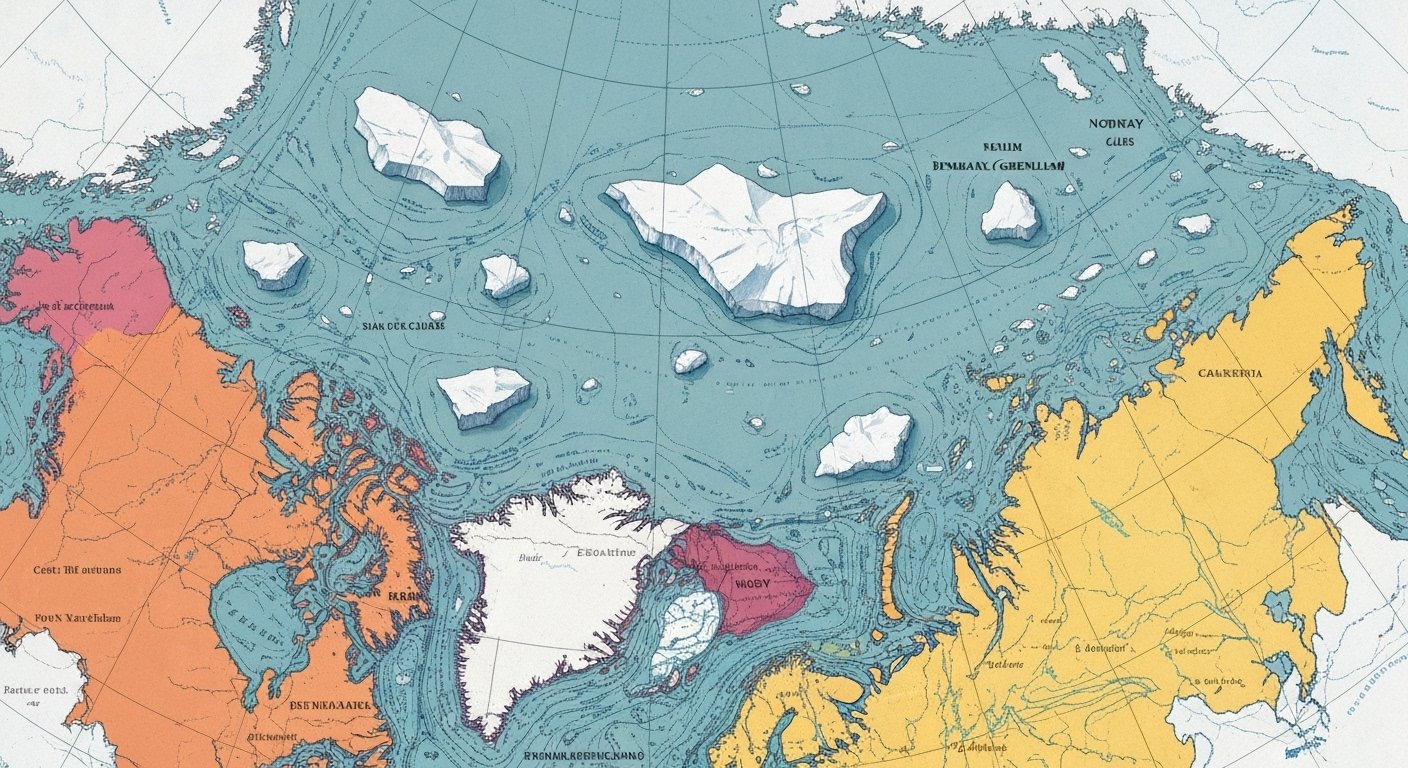
Now, let's talk Greenland. The desire to acquire this massive, resource-rich, strategically critical island is not new—Trump coveted it even during his first term . But why would the U.S. fixate on a Danish territory when there are so many other pressing global issues? Well, the answer lies squarely in the rapidly shifting Arctic geopolitics . Greenland, a self-governing territory of Denmark, sits right on the edge of the Arctic Circle, a region heating up both literally and strategically.
Here’s a surprising fact: the Arctic, often thought of as an empty expanse, holds an estimated 13% of the world’s undiscovered oil and 30% of its undiscovered natural gas, not to mention vast reserves of rare earth minerals and uranium . These resources aren't just floating in the water; they are tied to the continental shelf beneath the seabed. Under international law, coastal nations are entitled to a 200 nautical mile Exclusive Economic Zone (EEZ) where they control all resource exploitation . Since the U.S. already controls Alaska and its EEZ, acquiring Greenland—which would provide an enormous EEZ and access to potential claims extending 350 nautical miles further—would solidify the U.S. as a true top-two power in the region, second only to Russia.
This move is fundamentally driven by a desire to counter the growing military and economic consolidation between Russia and China in the region . Russia already dominates the Arctic, possessing a massive 53% of the Arctic coastline and 90% of the active Northern Sea Route . Furthermore, Russia maintains a huge military footprint, with 32 permanent military bases compared to the U.S.'s 10, plus nearly 500 other military sites . When the Arctic Council effectively paused cooperation with Russia after the Ukraine war, Russia simply pivoted hard to China, inviting an increasingly assertive non-Arctic power into resource projects. Trump's perceived solution? Acquire Greenland to build a massive counter-bloc (Alaska + Greenland + potentially Canada's share) to compete economically and militarily with the Russo-Chinese partnership, without relying on traditional NATO allies.
Can Europe Stop the US from Pursuing Its Own Interests?
Many European nations, especially Denmark, are rightfully outraged by the idea of the U.S. simply attempting to buy or coerce Greenland. The Danish Prime Minister even suggested that if the U.S. pursued the acquisition violently, it could risk breaking up NATO . But can Europe really prevent this? I’ve found that European leverage against the U.S. is surprisingly weak when we look at the raw numbers. Here’s why: Europe’s military preparedness, outside of Russia and wartime Ukraine, is shockingly low.
If you compare active military personnel in Europe, Russia has about 1.32 million, and Ukraine currently has 900,000 (due to full mobilization) . Then look at the rest of major European nations: France, the UK, and Germany all have standing armies of fewer than 200,000 personnel . This reality—that European nations simply cannot defend themselves without massive American assistance—is why breaking away from NATO, despite frustrations, is a non-starter. Europe is effectively leveraged and has little negotiating room.
Furthermore, Trump’s strategy isn't about alienating Russia; it's about collaborating with them on terms favorable to the U.S., specifically in the Arctic. He has prioritized U.S.-Russia cooperation in the Arctic, even at the expense of traditional NATO allies like Canada and Denmark . This is a massive counterintuitive insight: the U.S. prioritizes cooperation with a geopolitical rival (Russia) to manage an emerging region (the Arctic) while challenging the territorial integrity of long-standing NATO allies. And what about the people of Greenland? While 85% initially oppose joining the U.S., 60% favor independence from Denmark . If the U.S. were to offer significant financial incentives—say, a generous $100,000 per person to the small population of 57,000, totaling a mere $5.7 billion for a resource-rich territory twenty times the size of the UK —the political landscape could change quickly, potentially creating an "American Crimea" scenario where local will, backed by a superpower, overrides international objection.
Ultimately, these interconnected moves—challenging Venezuela, downplaying Europe, and targeting Greenland—all stem from a unified strategic doctrine: the world is divided into great power zones, and the U.S. must ruthlessly secure its own, even if it means negotiating with past foes (Russia) and elbowing out current friends (NATO) to consolidate resources and power.