The Unseen Aftermath(2/2): How Trump's Taiwan Gambit Exposed China's Weakness
Remember that big U.S.-China summit everyone was talking about? The one where the world held its breath, wondering if these two giants could find common ground? Well, if you were expecting a grand resolution, you might have been a little disappointed. But what if I told you that beneath the surface, something far more significant was unfolding, something that actually put China on the back foot?
It's easy to get caught up in the headlines, the official statements, and the perceived outcomes. But sometimes, the real story lies in what isn't said, or in the subtle shifts in power dynamics. In the recent U.S.-China talks, while the market focused on trade deals and tariffs, the true strategic play was happening elsewhere, and it involved a surprising turn of events that left China's vulnerabilities exposed.
The Shifting Sands of Global Finance: Beyond Traditional Currencies
Before we dive into the geopolitical chess match, let's talk about the bigger economic picture, because it's the undercurrent that shapes everything. We're living in an era where the very definition of money is changing. Gone are the days when traditional currencies, backed by governments, were the sole players. Now, we're seeing a clear trend towards securitization, assetization, and financialization, driven by what's known as Modern Monetary Theory (MMT). This isn't just a short-term fad; it's a fundamental shift that could define the next few decades.
This new financial landscape is pushing us towards stablecoins and other digital assets, where the government itself is actively seeking to legitimize new forms of currency. It's almost ironic, isn't it? Historically, establishing a stable currency was a century-long struggle for European monarchies. Yet, today, governments are embracing new monetary forms, almost as if acknowledging the limitations of their traditional tools. Money, in this new paradigm, is no longer just a medium of exchange or a measure of value; it's a tool for creating more credit, more assets, and more financial instruments. This underlying framework, this "money-printing" mentality, isn't going anywhere soon.
China's Self-Inflicted Wound: The Taiwan Card
Now, let's get back to the U.S.-China summit. On the surface, the discussions revolved around predictable topics: trade, tariffs, and technology. The U.S. wanted things like Boeing orders, beef imports, and investment committees, while China pushed for tariff reductions, tech access, and, notably, discussions about Taiwan. But here's the kicker: despite all the fanfare, the fundamental relationship between the two nations remained unchanged. They're still two opposing poles, and when they get too close, they tend to repel. True peace, in this dynamic, often comes from maintaining a healthy distance.
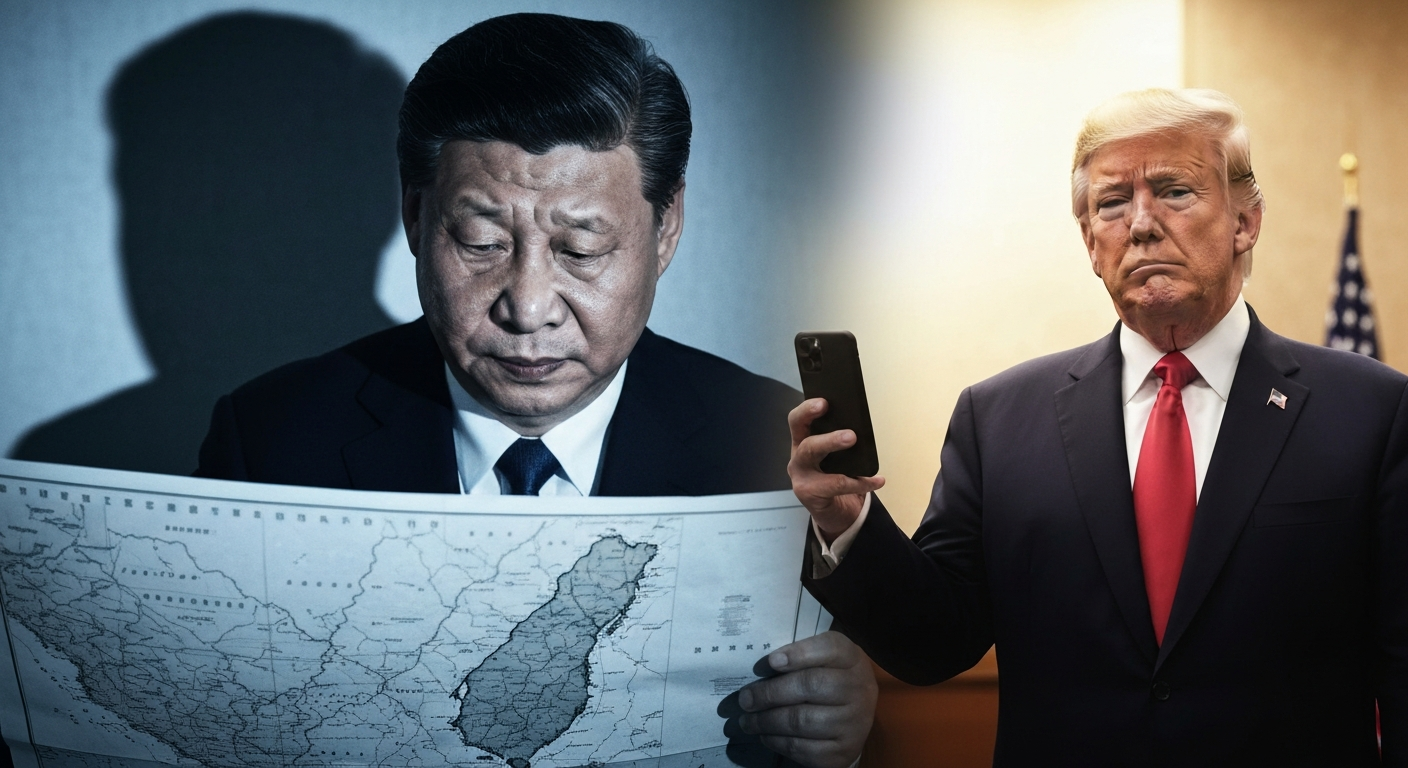
What truly stood out, in my opinion, was China's unexpected move. While the U.S. delegation, led by Trump, was careful not to bring up sensitive issues like Iran – precisely to avoid owing China any favors – Xi Jinping immediately brought up Taiwan. This was a critical misstep. By proactively raising the Taiwan issue, China inadvertently exposed its deepest geopolitical vulnerability. It was like showing your hand in a poker game before anyone else had even bet.
You might think, "Well, Taiwan is obviously a critical issue for China, so it's natural they'd bring it up." But here's the thing: at that moment, Taiwan wasn't even on the official agenda. By making it a central point of discussion, China signaled to the U.S. just how much it cares about the issue, effectively handing the U.S. a powerful leverage point. If Xi hadn't mentioned Taiwan, Trump would have been left without a clear "pivot point" – a key issue to press China on, whether it was Iran or technology exports. Instead, China handed it to him on a silver platter.
The Evolution of U.S. Taiwan Policy: A Growing Threat to Beijing
This isn't a new development, of course. The U.S. has a long history of engaging with Taiwan, but the nature of that engagement has evolved significantly, much to China's chagrin. The Taiwan Relations Act of 1979, for instance, allowed for arms sales to Taiwan but still acknowledged a certain level of interdependence between China and Taiwan. This meant that when the U.S. dealt with Taiwan, it would often inform or consult with China.
However, things changed dramatically with the Taiwan Travel Act, enacted during Trump's first term in 2018. This law allowed high-level U.S. and Taiwanese officials to directly interact, bypassing China entirely. Beijing reacted with fury, and for good reason. The act also included a crucial clause, often overlooked, that essentially warned China against any military action regarding Taiwan's territorial integrity. This was a clear message: the U.S. had already laid the groundwork to counter any aggressive moves by China.
Fast forward to 2020, and the U.S. further solidified its stance with the Taiwan Assurance Act and the Taiwan Allies International Protection and Enhancement Initiative (TAIPEI Act). These acts are incredibly significant because they directly challenge China's "One China" policy. For Xi Jinping, Taiwan isn't just a territorial claim; it's a crucial strategic asset, particularly due to its position within the "First Island Chain." This chain, stretching from Japan through Taiwan and the Philippines, is vital for projecting power into the Indo-Pacific and beyond. By protecting Taiwan and its allies in the Oceania region, the U.S. is effectively creating a barrier, preventing China from expanding its influence into the Pacific and Indian Oceans.
The Desperate Diplomat: Trump's Unexpected Play
So, why did Trump, seemingly in a position of strength, bring a delegation of top CEOs to China, only for the talks to appear somewhat anticlimactic? It's a question that puzzled many. On the surface, it looked like a missed opportunity, especially given the high-profile attendees. But if you look closer, you'll see a subtle desperation on Trump's part, a need to secure some kind of win, even if it wasn't the one everyone expected.
Trump's administration, despite its tough talk, was facing domestic economic pressures. The "crowding out effect" of his initial policies, where government spending stifled private investment, was starting to show. Manufacturing was struggling, and only big tech companies were thriving. He needed a boost, a way to inject more money into the economy, and China, despite the ongoing trade tensions, was a potential source. He even took a page from his previous playbook, where he would impose tariffs, then negotiate them down, creating a sense of progress. This time, however, China's unexpected move changed the game.
The fact that Trump brought along CEOs from companies like Nvidia, hinting at massive potential deals, suggests he was looking for a significant economic win. But the U.S. had already withdrawn China's Most Favored Nation (MFN) status and ended permanent normal trade relations, effectively signaling a desire to decouple economically. So, why the big show? It seems Trump was in a bind, needing to show some progress, but unwilling to make concessions. China's premature mention of Taiwan, however, gave him an unexpected advantage.
The Pivot Point: China's Concession and the Road Ahead
This brings us to the crucial takeaway: China's self-exposure on Taiwan has fundamentally altered the dynamic. By expressing its deep concern, China has effectively put itself in a position where it needs to offer concessions to the U.S. to soften the Taiwan issue. We've already seen a glimpse of this with China's tariff reductions, but I believe this is just the beginning.
The U.S. administration, particularly with the upcoming midterm elections, is under pressure to deliver economic stability and foreign policy wins. The Iran issue, initially a major concern, has become a direct U.S.-Iran conflict, freeing up the U.S. to focus its strategic attention elsewhere. China's move on Taiwan has provided that "elsewhere." It's a powerful leverage point that Trump can now use to his advantage, whether it's to secure more trade deals, influence global supply chains, or simply project an image of strength.
So, while the initial reaction to the U.S.-China summit might have been one of disappointment or uncertainty, the long-term implications are far more intriguing. The market's current anxieties about rising interest rates and hyperinflation might be overblown, precisely because China's actions have opened up new avenues for negotiation and potential de-escalation. Keep a close eye on China's next moves, especially as we approach September. Their willingness to make concessions on Taiwan could have a ripple effect, influencing everything from global interest rates to the stability of financial markets. This isn't the end of the story; it's just the beginning of a new chapter, one where China's own words have given the U.S. a powerful hand to play.