The Midterm Election Mystery: Why the Fed Might Hike Rates Even When the Economy Says No
We're diving deep into some fascinating insights today, exploring why the U.S. Federal Reserve might be gearing up for another rate hike, even when the data seems to be screaming the opposite. It's a bit like trying to solve a puzzle where half the pieces are missing, or worse, deliberately misleading.
Let's unpack this, because what's happening behind the scenes could have some pretty big implications for your investments and the broader market.
The Curious Case of the Conflicting Job Numbers
You know how we always hear about the latest employment figures? Well, it turns out not all job reports are created equal. There are actually two main ways the U.S. government measures employment: the establishment survey (which most news outlets focus on) and the household survey. And right now, they're telling wildly different stories.
The establishment survey, the one that usually makes headlines, suggests job growth is chugging along. But the household survey, which often gets overlooked, paints a much bleaker picture, showing employment actually going in the opposite direction. It's like one friend is telling you the party is still going strong, while another says everyone's already gone home. This discrepancy is a huge red flag for some economists, suggesting that the official narrative might be a bit too rosy.
What's more, the initial job numbers we see are often heavily revised later on. Sometimes, those revisions are massive, turning what looked like robust growth into something far more modest. This isn't just a minor tweak; it can fundamentally change our understanding of the labor market's health. For instance, recent data showed a significant downward revision in job growth, yet the Fed's hawkish stance seems largely unaffected. It makes you wonder if they're looking at the same numbers we are, or if there's another agenda at play.
The Illusion of "Full Employment" and the Missing Workers
Another piece of this puzzle is the unemployment rate. On the surface, a low unemployment rate sounds fantastic, right? It suggests a strong economy where everyone who wants a job can find one. But here's the catch: the unemployment rate only counts people who are actively looking for work. If you've given up looking, or if you've decided to leave the workforce entirely, you're not counted as unemployed.
This is where the "labor market participation rate" comes in, and it's been falling dramatically. A significant number of people are simply exiting the labor force. They're not unemployed; they're just not participating. This means the low unemployment rate might be an illusion, masking a deeper problem of a shrinking workforce. If fewer people are even trying to find jobs, the unemployment rate will naturally look lower, even if the economy isn't actually creating enough opportunities. It's like saying a marathon has fewer runners dropping out, but only because fewer people showed up to run in the first place.
So, when Fed officials point to a low unemployment rate as a sign of "full employment" and a reason to raise rates, they might be missing the bigger picture. The economy isn't necessarily robust; it might just be that a large segment of the population has disengaged from the job market. This trend, if it continues, is actually a negative sign for economic health, not a positive one.
The AI Factor and Inflated Job Creation
There's another intriguing theory about why the establishment survey might be overstating job growth, and it has to do with the rise of one-person businesses and the impact of AI. Traditionally, when a new business starts, it hires several employees. The establishment survey counts these new hires, contributing to the overall job growth figures.
However, in today's economy, we're seeing a surge in "one-person businesses," especially in the IT services sector, often powered by AI. These entrepreneurs might be creating a new company, which gets counted in the establishment survey as a "new business," but they're not necessarily hiring additional staff. Imagine someone starting an AI-driven marketing agency from their home. The business exists, but they might be doing all the work themselves, perhaps with the help of AI tools.
The problem is, the survey models might still be assuming that each new business creates multiple jobs, leading to an inflated estimate of employment. Meanwhile, the household survey, which directly asks individuals about their employment status, might capture the reality that these "new businesses" aren't actually adding many new jobs to the economy. This discrepancy could be a significant factor in why the official job numbers appear stronger than they truly are, leading to a misinterpretation of the economy's actual strength.
The Fed's Predetermined Conclusion: Rate Hikes and Political Agendas
So, if the employment data is questionable and inflation pressures aren't as sticky as some claim, why does the Fed seem so determined to raise interest rates? This is where things get a bit political. Some argue that certain Fed officials have a "predetermined conclusion" in mind: rate hikes. And once that conclusion is set, they'll find the data to support it, regardless of the broader economic context.
It's like having a strong bias against a particular political figure, say, a former president. If the goal is to make that figure look bad, then raising interest rates, which can slow the economy, might be seen as a way to achieve that. The argument goes that if the economy falters under a certain administration, it reflects poorly on them. So, even if the data suggests otherwise, the narrative of "full employment" and "sticky inflation" can be used to justify rate hikes.
This isn't to say that all Fed officials are driven by political motives, but it's a perspective that suggests their decisions aren't always purely data-driven. They might be looking for any justification to push for higher rates, even if it means overlooking contradictory evidence or focusing on specific metrics that support their pre-existing views. It's a concerning thought, especially when these decisions have such a profound impact on everyone's financial well-being.
The Midterm Election Pattern: A Century of Predictability
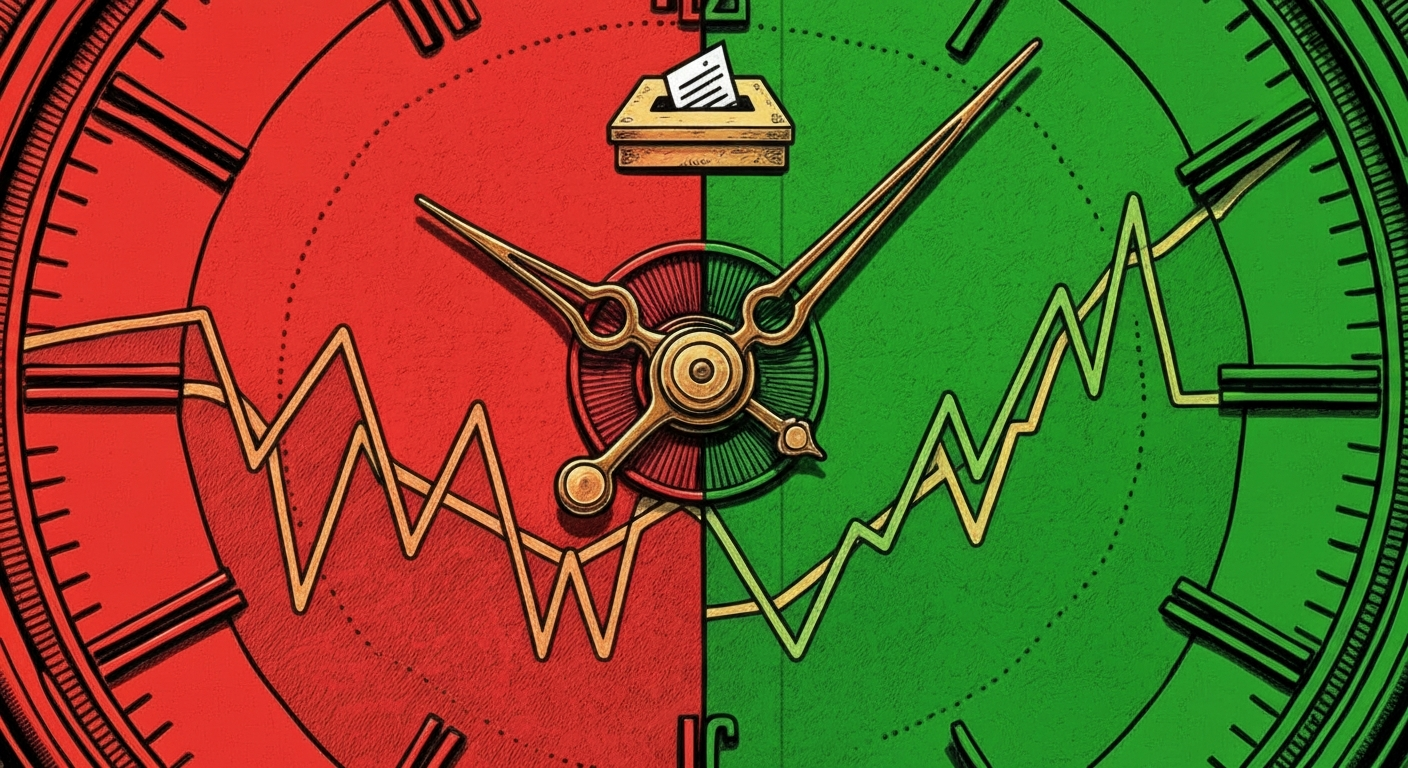
Now, let's talk about something that consistently happens in U.S. midterm election years, a pattern that has held true for over a century. Historically, the stock market tends to fall leading up to the midterm elections, and then, almost without fail, it rallies significantly after the elections. It's a remarkably consistent trend that has played out repeatedly over the last 100 years.
This pattern suggests that there's a certain level of uncertainty and perhaps even political maneuvering that impacts the market in the months leading up to the midterms. Once the elections are over, that uncertainty dissipates, and the market finds its footing again. This year, we're seeing a similar trend unfolding, with the market experiencing some turbulence before the elections. If history is any guide, we could be in for a rebound once the dust settles.
It's a fascinating historical anomaly that investors often keep an eye on. While past performance is never a guarantee of future results, a century of consistent behavior is certainly something to consider. It adds another layer of complexity to understanding market movements, suggesting that political cycles can have a tangible, predictable impact on your portfolio.
What Does This Mean for Your Investments?
So, what's the takeaway from all this? It seems we're in a period where economic data is being interpreted through a specific lens, and political considerations might be playing a larger role in monetary policy decisions than we'd like to admit. The official narrative of a strong job market and persistent inflation might not be telling the whole story, and the Fed's inclination to raise rates could lead to an "over-tightening" of monetary policy.
For investors, this means staying vigilant and looking beyond the headlines. Don't just take the initial job numbers at face value; understand the nuances and potential for revisions. Be aware of the political undercurrents that can influence central bank decisions. And remember the historical patterns around midterm elections – they might offer a glimmer of predictability in an otherwise uncertain market.
Ultimately, navigating this environment requires a critical eye and a willingness to question the prevailing wisdom. It's about understanding that the economic picture is often more complex than it appears, and that sometimes, what "always happens" in politics can have a surprising impact on your financial future.