The Global Economy's Next Chapter in 2026: Five Seismic Shifts We Can't Ignore
You know how the global economy feels less like a smooth highway and more like a rollercoaster with unpredictable loops? That’s exactly how it’s going be like next year in 2026. We often try to predict exact numbers for the coming year, but honestly, that's incredibly tough. Instead, let's focus on the big, critical issues—the key variables that will determine the shape of things to come, much like how Trump's tariffs and the subsequent market whiplash defined earlier periods . I've found that understanding these foundational pressures gives us a much better lens than trying to hit a specific forecast number. We're talking about fundamental shifts, the kind that could flip the entire script, and I've boiled it down to five major dynamics we need to keep an eye on.
Will Trump’s Tariff Policy Survive a Legal Challenge?
Here's the thing: a major decision regarding the legality of Trump’s reciprocal tariffs is looming, possibly in December or January, and its outcome could send ripples far beyond trade negotiations . Imagine if the Supreme Court rules these tariffs unconstitutional; that reciprocal tariff framework—which underpinned a huge part of the former administration's economic policy—could be immediately invalidated . This would trigger a massive problem where companies and countries that paid the duties could demand refunds, potentially requiring the US government to repay a staggering $2 trillion . From my experience, any action that puts that kind of pressure on the Treasury is a massive market-mover.
What’s interesting is how the tariff system worked in tandem with tax cuts to create a delicate balance . Tariffs, while raising revenue for the government and offsetting the cost of tax cuts, simultaneously stifle economic growth by discouraging trade . Conversely, those huge tax cuts stimulate the economy, effectively compensating for the growth loss caused by the tariffs . Now, if the tariff leg of this three-legged stool (which also includes deregulation) is chopped off, the resulting drop in tax revenue could drastically worsen the fiscal deficit—a major concern given current US debt levels . This legal challenge isn't just about trade; it's a huge potential catalyst for renewed national debt risk, which is something global markets, including Japan, France, and Germany, are increasingly scrutinizing .
A truly counterintuitive insight, however, comes from the fact that even if the tariffs are struck down, Trump may simply introduce a new system to replace them, but the uncertainty alone could be enough to destabilize markets . Remember the term "Elevate to Deliberate"? Treasury Secretary Steven Mnuchin once said the core of the administration’s tariff strategy was to raise them only to lower them later, using high rates like 30% as leverage to force countries to the negotiating table . He even compared tariffs to "ice that must melt" once trade imbalances are resolved, suggesting that they were never meant to be permanent fixtures . This suggests that the administration might welcome a chance to use a 'new' system to strategically adjust rates, but the initial confusion would still rock the boat. This ruling is our first major flashpoint of the year, so let's keep a sharp eye on those Supreme Court calendars.
Is a Federal Reserve Leadership Shift Inevitable?
Moving past trade, the next big issue, likely to heat up in the second quarter around April or May, involves a potential changing of the guard at the Federal Reserve . We all know Fed Chair Jerome Powell has endured consistent criticism from the administration, even being called "Mr. Too Late," but what’s crucial now is the growing likelihood of replacement . While we don't know the exact successor, key allies like Kevin Hassett are being floated as likely candidates, someone who would undoubtedly be more inclined to accommodate the administration's preference for lower interest rates than Powell .
This situation isn’t just about the top job, though; the strategic filling of vacant governor positions matters just as much. For example, the current Fed Board of Governors features figures like Steve Myron, a known advocate for aggressive rate cuts, who is set to depart in January . It’s plausible—and a scenario gaining traction in the media—that the eventual Fed Chair nominee (say, Hassett) could be appointed to that vacant board seat first . Now, imagine having the future Fed Chair sitting as a voting member before their official appointment—that creates a massive lame duck scenario, seriously undermining Powell’s influence over monetary policy decisions like the Dot Plot .
What’s the surprising twist here? Historically, the Treasury Secretary (like Mnuchin) has intervened to protect the Fed Chair, not because they loved the person, but because they recognized that attacking the central bank's independence—its sole focus on inflation—could panic markets and actually cause inflation to rise . This time, however, the shift is happening not through a dramatic firing, but through a slow, deliberate erosion of control and ideological alignment, pushing the Fed toward policies that, while aimed at stimulating growth, might inherently carry inflationary risks. If the markets start to believe the Fed is compromising its inflation-fighting mandate, we could see significant volatility emerge around that Q2 transition period .
Can the GOP Maintain Control Through Midterm Elections?
Let's zoom out a bit and look at the political landscape, specifically the upcoming mid-term elections in November, which tend to heat up dramatically around the third and fourth quarters . The outcome of these elections is vital because the current administration achieved massive power in the last election by securing the Presidency, the Senate, and the House . A loss of the House, similar to what happened during the previous administration's first term in 2018, could significantly weaken the administration's mandate and increase the risk of a lame-duck presidency . If the support base continues to erode, as suggested by recently reduced approval ratings, the administration will be under enormous pressure to boost public sentiment through immediate policy actions .
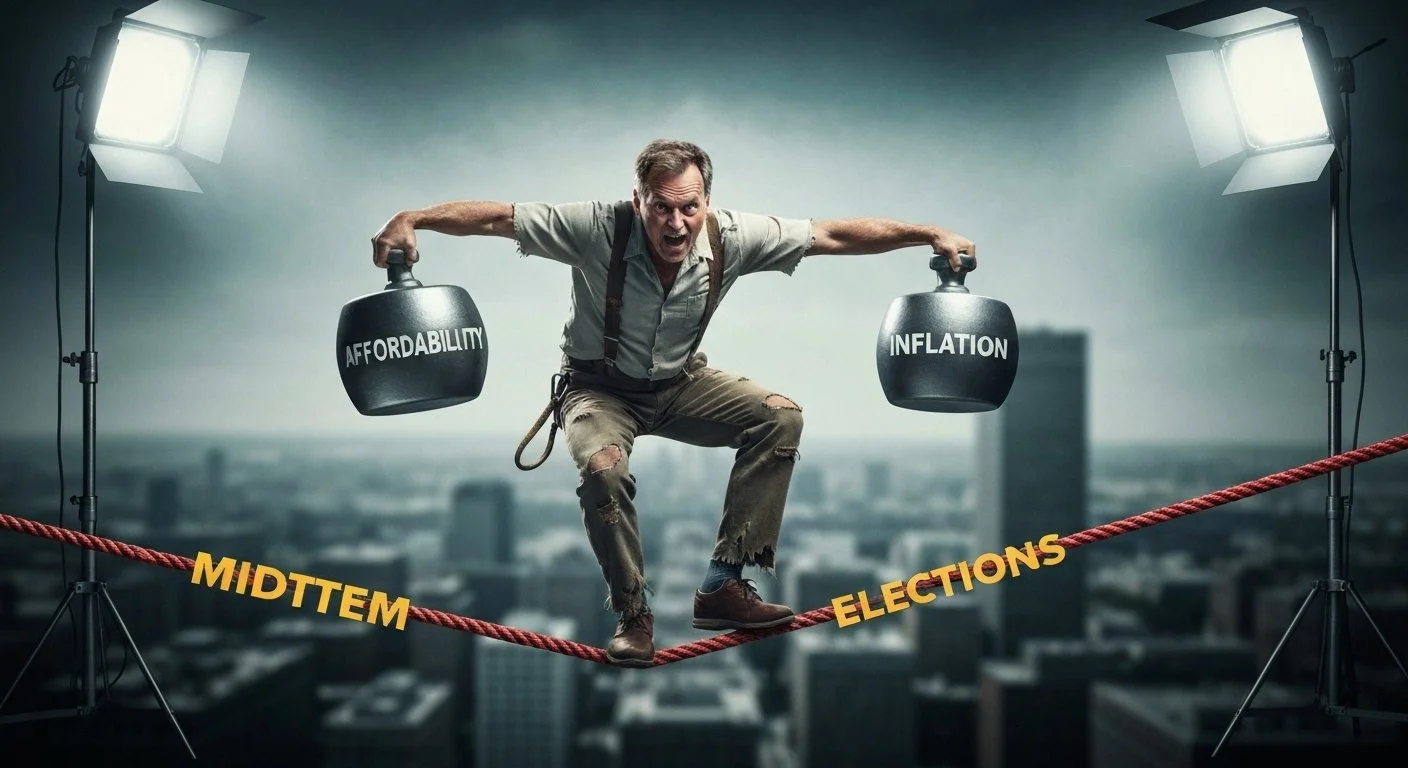
This leads us directly to the concept of "affordability," a term that gained major traction after the surprising victory of socialist-leaning candidate Zoran Mamdani in the New York City mayoral election . Mamdani campaigned heavily on the high cost of living, focusing specifically on skyrocketing rent prices and the need for higher wages to restore people's ability to afford basic necessities . This focus on economic inequality and affordability is almost certain to become a central theme in the national midterms, particularly if inflation pressures continue to rise . Consequently, the administration might be incentivized to pursue policies that directly impact household budgets, such as pushing for wage increases or even distributing funds collected via tariffs to low-income populations, a tactic that has already been floated in the news .
The truly surprising way these political pressures intersect with economic policy is through the administration's willingness to use tariffs as a flexible political tool. For instance, to alleviate the cost-of-living crisis and inflation concerns (which hurt affordability), the administration has been known to strategically exempt essential goods, such as coffee, bananas, and cocoa imported from Central and South America, from tariffs . This action is a classic 'TACO' move (Tariffs Are Constantly Omitted or adjusted) and demonstrates that the tariff wall isn't rigid; it’s negotiable, especially when political survival—and controlling inflation ahead of an election—is on the line . Thus, the need to win the midterms might actually lead to policy combinations, including tariff adjustments and targeted stimulus, that run counter to the administration’s typical hard-line stance.
Are We Entering a New Era of ‘Great Divergence’?
Stepping back from domestic politics, let's look at a critical global phenomenon: the "Great Divergence," which we previously saw in 2015 when the US raised interest rates for the first time post-financial crisis, while Europe simultaneously initiated quantitative easing . Here’s why I think we might see a rerun: while the US is actively considering rate cuts, numerous other central banks are moving in the opposite direction, creating a massive fragmentation in global monetary policy .
Think about it: just recently, the Reserve Bank of Australia openly discussed the possibility of raising rates due to lingering inflation concerns, and Canada signaled a halt to its rate-cutting cycle . Even in Europe, officials have suggested they might need to change course, possibly pausing rate cuts or even hiking again . Meanwhile, the Bank of Japan is actively moving toward rate hikes, and the Bank of Korea maintains a cautious, watchful stance rather than engaging in aggressive cuts . This creates a highly complex multi-variable equation where different countries are all adjusting their policy rates—hiking, holding, or cutting—simultaneously .
This is fundamentally different from synchronized global tightening or easing. When central banks act in unison, it makes predicting currency fluctuations relatively straightforward. But when you have this "Great Divergence," where policies move in entirely different directions, the variables influencing global exchange rates become incredibly difficult to solve . From my experience, dealing with investors who ask about precise future exchange rates in this environment is the scariest thing, because the variable-laden environment makes certainty impossible . This divergence of policy—the US potentially easing while others tighten or hold—is set to amplify volatility in global capital flows and particularly in FX markets.
How Will China’s New Economic Blueprint Alter Global Trade?
Finally, let's look east, focusing on the changing dynamics in China and Japan, which will continue to exert substantial global influence . China is currently mapping out its new Five-Year Plan, laying the groundwork for its economic future, and what’s striking right now is the unexpected strength of the Chinese Yuan (CNY) . The Yuan is traditionally a stable currency but it has recently appreciated significantly against the US Dollar . Earlier this year, the dollar bought about 7.3 Yuan; now, it buys closer to 7.06 Yuan .
This strengthening currency is a huge signal. A weaker currency generally favors exports, but a stronger currency suggests a deliberate pivot toward prioritizing domestic consumption and growth . This movement is significant because it aligns with the concept of "Great Rebalancing," an idea pushed by officials like Mnuchin, who argued that China needed to shift from being purely an exporter to becoming a major consumer of foreign goods, including those from the US . If China successfully boosts its domestic demand, it could create new export opportunities for the US and other countries, fundamentally altering global trade flows .
In short, the strong Yuan suggests that China might be actively pursuing a different growth model than the export-driven one we're used to, moving toward a more internally robust economy . While it’s too early to declare a complete rebalancing, this policy shift, combined with Japan’s move toward hiking rates (leading to potential Yen volatility), means that investors must pay close attention to the evolution of these major Asian economies . These changes, whether driven by internal policy goals or external pressure, will reshape global supply chains and trade dynamics throughout the year.
So there you have it: five intertwined pressure points that will likely define the coming year. We've got the tariff verdict in Q1, the potential Fed shake-up in Q2, the building political pressure of the midterms in Q3/Q4, the global monetary policy divergence happening right now, and the subtle yet powerful economic re-engineering in China . None of these issues operate in isolation; they’re all connected, often in surprising ways. Instead of seeking simple answers, focusing on how these key variables interact will give us the smartest vantage point to navigate the volatility ahead. Thanks for reading!