Is Trump's Manufacturing Dream a Mirage? A Look at the US Economic Tightrope
Are those big promises about bringing manufacturing back to the US are truly sustainable? You know, the kind of talk we hear about making America a manufacturing powerhouse again? It’s a compelling vision, for sure, especially when we consider all the talk about economic growth and job creation. But here’s the thing, when you dive deep into the US economic structure, it gets a little more complicated than a simple "build it and they will come" approach. What's interesting is how some policies, even with the best intentions, can create a bit of an economic headwind.
From my experience, looking at these complex economic scenarios, it’s not always about what sounds good on paper, but how it actually plays out in a deeply interconnected system. Take, for instance, the ambitious plans to boost US manufacturing; while the goal is clear, the current financial and consumption-driven economic model in the US actually works quite against it . It's almost like trying to drive a car forward by simultaneously pressing the gas and the brake. This push-and-pull dynamic is something even experts like Yoo Shin-ik, an economist from KBWM Star Advisory, point out, suggesting that some of these policies are fundamentally at odds with each other and are, in fact, "doomed to fail" . It really makes you think about the deeper forces at play in a globalized economy.
Why Can't America Just "Make More Stuff" Domestically?
So, you might be asking, why can't the US just shift gears and become a manufacturing nation again? It sounds straightforward, right? Well, here's where it gets a bit counterintuitive. The US economy, as it stands, is heavily skewed towards financial exports and consumption . Imagine a giant bathtub that's constantly being filled with water from financial activities and then drained out through consumer spending. This cycle keeps the GDP growth high, but it also means the government is always running a deficit, relying on external money from financial exports . It's a structure that makes fostering manufacturing incredibly difficult because the foundational elements of the economy are designed for something else entirely.
This leads us to a surprising fact: despite all the money flowing into the private sector, there's a significant "missing" amount. For example, while the government might inject around $39 trillion into the private sector through various means, the nominal GDP of the private sector recently stood at about $29 trillion . Where did that $10 trillion go? A substantial portion of this difference, roughly $2.7 trillion, is actually lost to interest costs from financial exports and a consistent decline in net exports . So, even as money circulates, a large chunk is essentially siphoned off by financial mechanics rather than directly fueling domestic production. It really highlights how the intricate financial plumbing of the economy can overshadow the simple goal of producing more goods.
Is More Money Always the Answer for Economic Growth?
When the economy seems to slow down, what's often the first instinct of many governments? To inject more money, usually by issuing more national debt and increasing budgets . And for a while, this strategy can actually work, you know, stimulating consumption and boosting GDP. Companies might invest, hire more people, and things feel good . But here's the kicker, there's a point where this constant injection of funds starts to have diminishing returns, leading to what economists call the "crowding-out effect" . It's a phenomenon where government borrowing pushes up interest rates, making it less attractive for private businesses to invest.
I've found that this crowding-out effect is a really crucial, yet often overlooked, part of the puzzle. When the government issues more debt to pour money into the system, interest rates tend to rise, and so does the dollar's value . For businesses, higher interest rates mean that borrowing money for investments becomes more expensive, and a stronger dollar makes their exports less competitive. So, after an initial spurt of growth, companies might start to pull back on investments, negating some of the positive effects of the money injection . It’s like constantly adding fuel to an engine that’s already running inefficiently – you might get a temporary boost, but the underlying issues remain, ultimately limiting sustainable growth.
Are US Consumers Really Supporting Domestic Manufacturing?
Let's talk about the American consumer for a moment, because you know, their choices really shape the economy. On the surface, it seems like a healthy cycle: big companies like the M7 tech giants grow, people consume a lot, and this should theoretically stimulate investment and production . But when we dig a little deeper, the reality is quite different. The US is a consumption-driven nation, sure, but a massive portion of that consumption isn't actually driving domestic manufacturing of the goods people truly need.
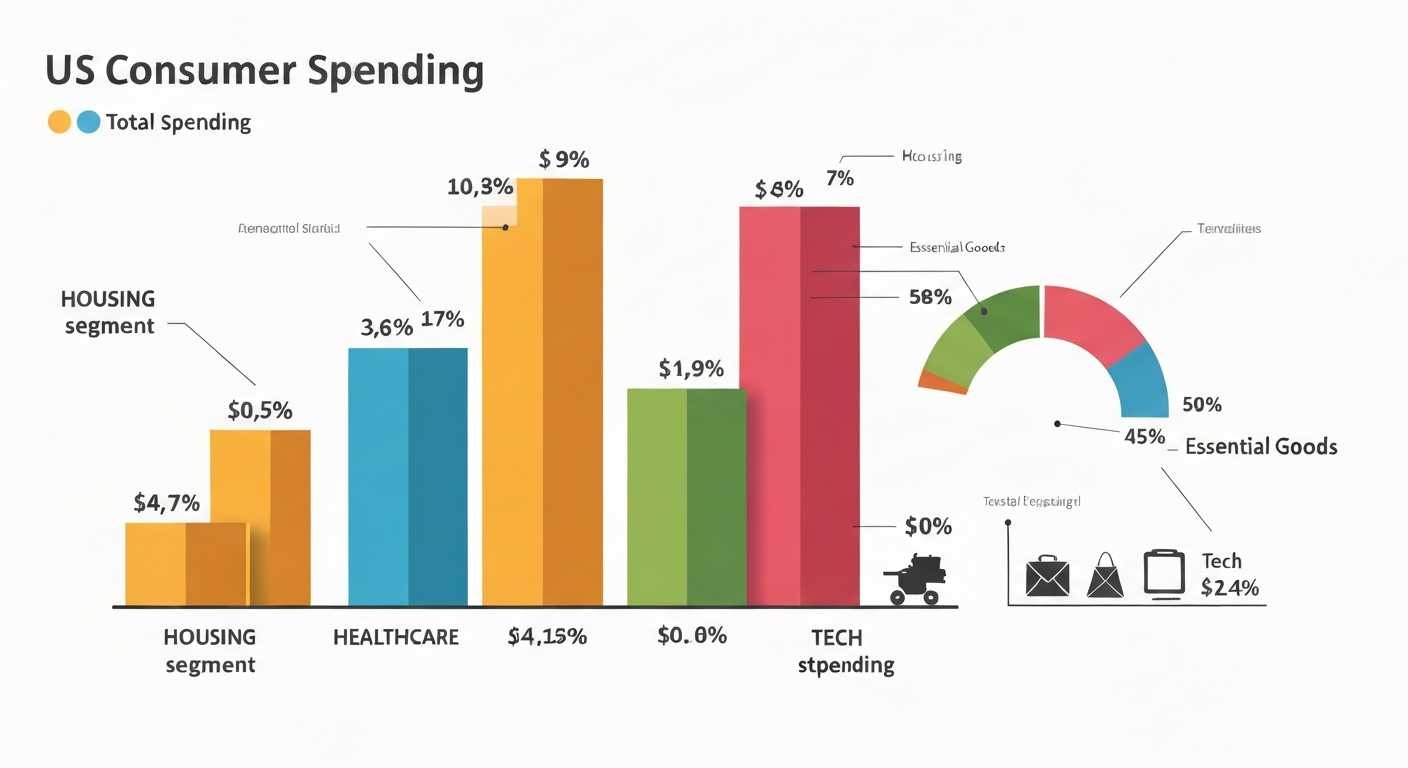
Here's a surprising insight: out of roughly $26 trillion in total household income, after taxes and essential services like healthcare (which alone takes up 22% of total consumption) and housing (20%), only about $6 trillion is left for purchasing goods . And get this: the US domestic manufacturing capacity can only supply about $2.5 trillion worth of those goods . This means there's a persistent gap of $3-4 trillion in goods that the US simply doesn't produce enough of domestically, including necessities like plastics, wood products, and even some durable goods . So, despite all the talk of growth and spending, Americans are essentially compelled to buy these essential goods from overseas, creating an inescapable reliance on imports. This imbalance truly underscores why a simple focus on 'reshoring' manufacturing without addressing the deeper structural issues can be an uphill battle.